
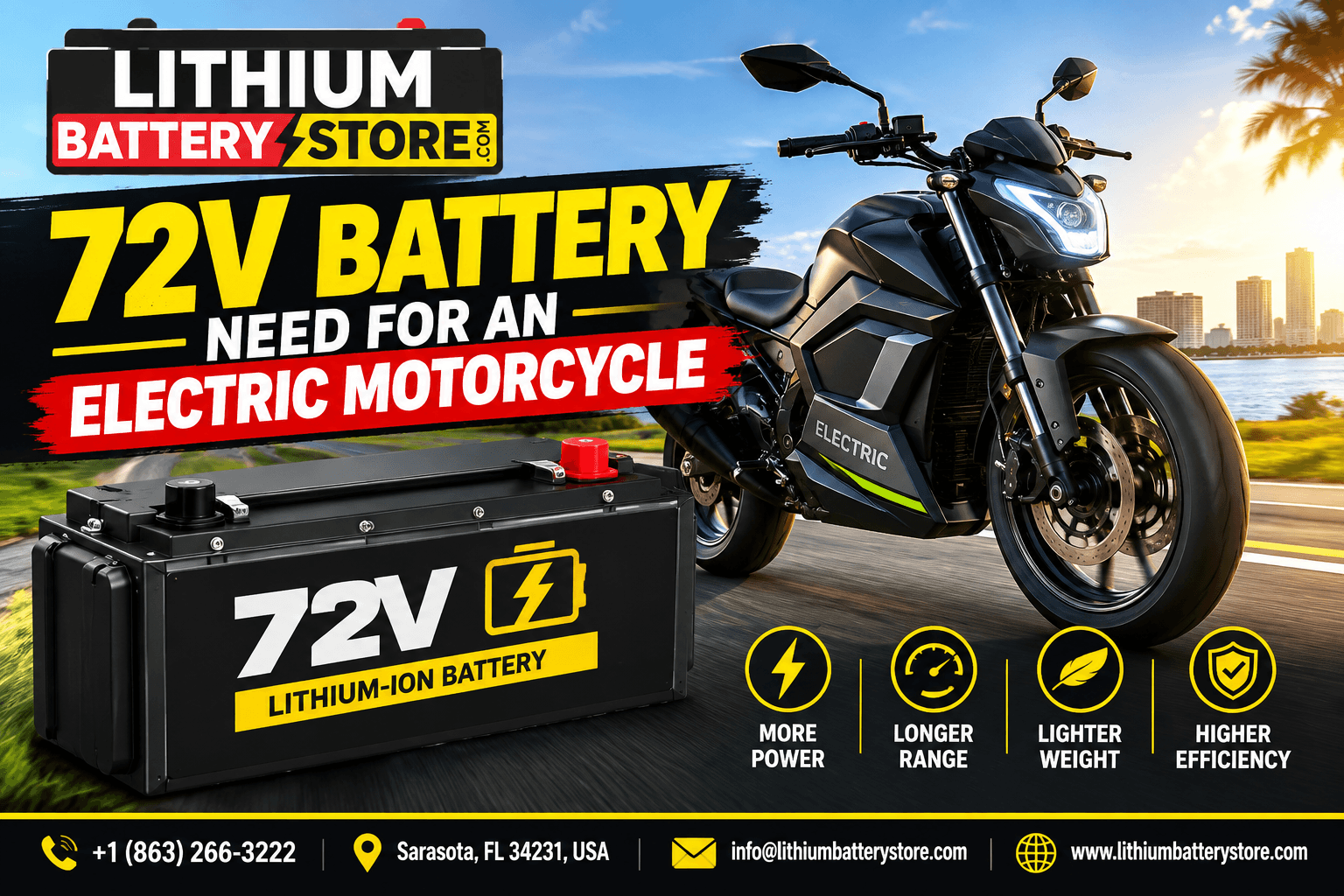
What Size 72V Battery Do You Need for an Electric Motorcycle?
Choosing the right battery is one of the most important decisions when building, upgrading, or replacing an electric motorcycle power system. A 72V battery can deliver strong performance, but voltage alone does not determine how far the motorcycle can travel or how long it will operate between charges.
Battery capacity, measured in amp-hours (Ah), motor power, controller requirements, riding conditions, vehicle weight, and charging needs all influence the right battery size. Understanding these factors can help you select a 72V electric motorcycle battery that provides the right balance of performance, range, weight, and reliability.
Understanding Electric Motorcycle Battery Voltage
Electric vehicle batteries are commonly available in several voltage categories. Smaller systems may use 12V batteries, while larger electric vehicles can require 24V, 36V, 48V, 60V, or 72V battery systems.
For example:
- 12V batteries are commonly used for auxiliary electrical systems and smaller applications.
- 24V batteries can be found in compact electric equipment and light-duty vehicles.
- 36V batteries are popular in smaller electric mobility applications.
- 48V batteries are widely used in electric scooters, bikes, and utility vehicles.
- 60V batteries can provide higher system voltage for performance-oriented electric vehicles.
- 72V batteries are often selected for electric motorcycles and other applications requiring higher power and performance.
A 72V system can support higher power requirements, but the battery must still be correctly matched with the motorcycle’s motor, controller, charger, and electrical architecture.
What Does 72V Mean for an Electric Motorcycle?
A 72V battery provides the nominal voltage required by a compatible electric motorcycle system. However, two 72V batteries can provide very different levels of performance because their capacity and maximum discharge capabilities may differ.
For example, consider these simplified battery configurations:
- 72V 20Ah = approximately 1.44 kWh
- 72V 30Ah = approximately 2.16 kWh
- 72V 40Ah = approximately 2.88 kWh
- 72V 50Ah = approximately 3.60 kWh
- 72V 60Ah = approximately 4.32 kWh
The basic energy calculation is:
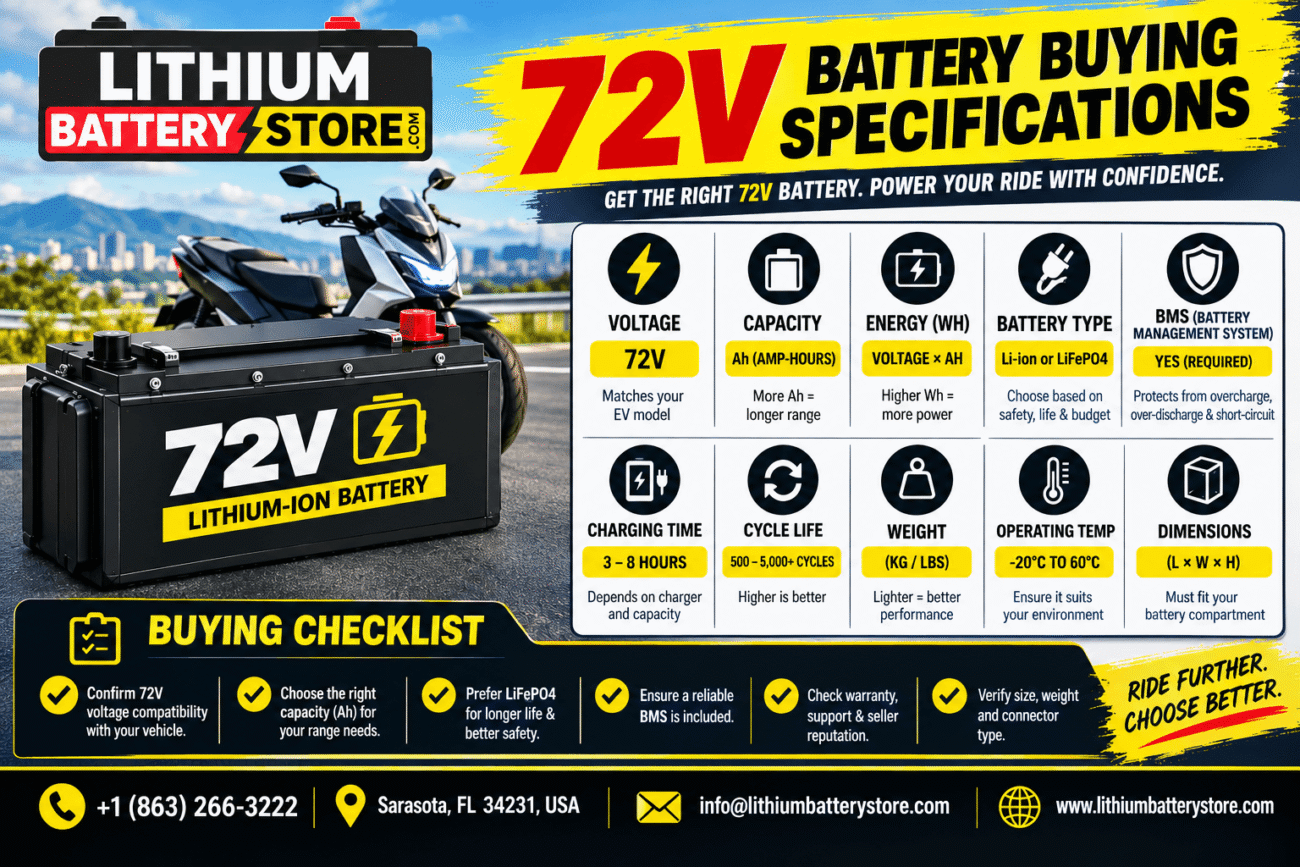
Voltage × Amp-hours = Watt-hours
Therefore:
72V × 40Ah = 2,880Wh, or 2.88kWh
Actual usable energy will depend on battery management settings, operating conditions, and the manufacturer’s specifications.
How Many Ah Do You Need?
There is no single Ah rating that is ideal for every electric motorcycle. The appropriate capacity depends primarily on the motorcycle’s energy consumption and the range you want.
A smaller 72V battery, such as a 20Ah or 30Ah pack, may be suitable for a lightweight motorcycle used for shorter trips. A 40Ah or 50Ah battery may be more appropriate when longer range is required.
For riders who regularly travel longer distances, a 60Ah or larger battery may provide additional energy capacity, provided the motorcycle has enough physical space and the battery’s weight is acceptable.
The important point is that higher Ah generally means more stored energy, but it also usually means greater battery size and weight.
How to Estimate Your Required Battery Capacity
A practical way to estimate battery requirements is to start with the motorcycle’s expected energy consumption.
Suppose an electric motorcycle uses approximately 50Wh per mile and you want around 60 miles of theoretical range.
The calculation would be:
50Wh × 60 miles = 3,000Wh
At 72V:
3,000Wh ÷ 72V ≈ 41.7Ah
In this simplified example, a battery around 42Ah would theoretically provide the required energy. In real-world use, however, it is wise to account for factors such as hills, acceleration, rider weight, temperature, wind, traffic, and battery reserve.
This means a slightly larger capacity may be appropriate rather than selecting a battery based only on the theoretical calculation.
72V Battery Size by Riding Requirements
Your riding pattern can help narrow down the battery capacity.
Short Urban Trips
For short commutes and local riding, a 72V 20Ah–30Ah battery may be sufficient for some electric motorcycles. The advantage is lower weight and potentially easier installation.
Daily Commuting
For regular commuting, a 72V 30Ah–50Ah battery may provide a useful balance between range and battery size, depending on the motorcycle and riding conditions.
Long-Distance Riding
For longer journeys, riders may consider 72V 50Ah–60Ah or larger batteries. These packs provide more stored energy but require additional space, weight capacity, and charging considerations.
These are general categories rather than universal recommendations. Always check the motorcycle manufacturer’s electrical and physical specifications before selecting a battery.
Don’t Choose a Battery Based on Ah Alone
Amp-hours are important, but they are not the only specification to consider.
A suitable 72V electric motorcycle battery should also have an appropriate continuous discharge current and peak discharge capability.
For example, a high-powered motor may require substantial current during acceleration or climbing. If the battery cannot safely deliver the current demanded by the controller, performance may suffer and the battery system could experience excessive stress.
The battery’s Battery Management System (BMS) should therefore be compatible with the expected current requirements.
Match the Battery With the Motor and Controller
A 72V battery should be compatible with the motorcycle’s complete electrical system.
Before purchasing a battery, check:
- Motor voltage requirements
- Motor power rating
- Controller voltage range
- Controller maximum current
- Battery continuous discharge current
- Battery peak discharge current
- Charger voltage and charging current
- Connector type
- Physical battery dimensions
- BMS specifications
A battery should never be selected simply because it is labeled “72V.” The complete system needs to work together safely and correctly.
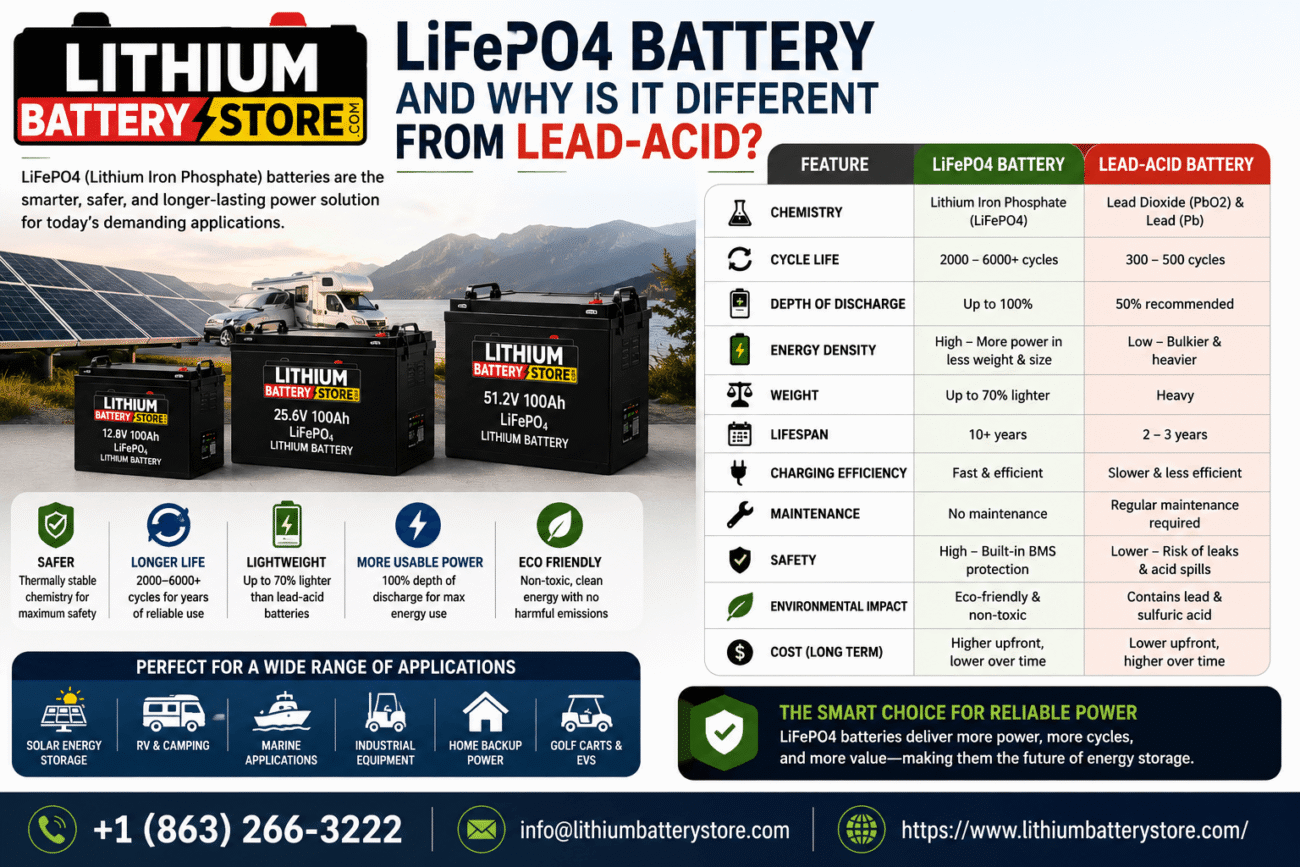
72V Lithium Battery Chemistry Matters
Battery chemistry can also influence performance, weight, lifespan, and safety.
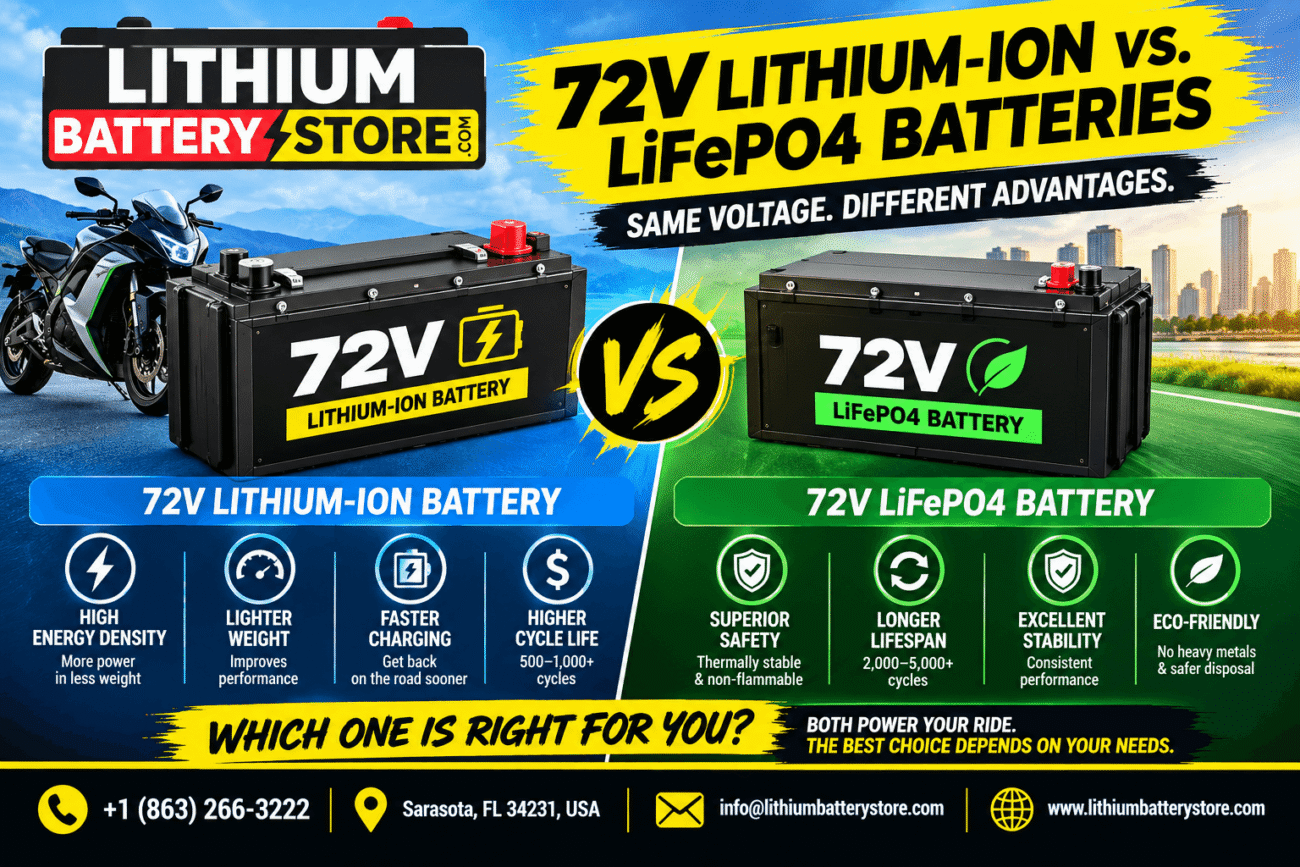
Lithium-ion battery systems are popular for electric motorcycles because they can provide substantial energy in a relatively compact package. Different lithium chemistries have different characteristics, so the appropriate choice depends on the vehicle design and intended use.
For example, some applications prioritize energy density and compact size, while others may place greater emphasis on durability, thermal characteristics, or cycle life.
When comparing batteries, look beyond the voltage and Ah rating and review the manufacturer’s chemistry, cycle-life specifications, BMS design, charging requirements, and operating-temperature range.
Why Battery Weight Matters
A larger battery can increase range, but additional battery weight can also affect motorcycle handling and efficiency.
A 72V 60Ah battery stores significantly more energy than a 72V 20Ah battery, but it may also require more installation space and add considerable weight.
For this reason, the “largest battery possible” is not automatically the best choice.
The goal should be to find the smallest practical battery that provides the required range and power without compromising the motorcycle’s performance or operating requirements.
How Charging Requirements Affect Your Choice
Battery capacity also affects charging time.
A larger battery generally requires more energy to recharge. Charging time depends on the battery’s remaining charge, charger output, battery management system, charging limits, and other factors.
For daily commuters, charging convenience can be just as important as maximum range. A battery that comfortably covers the daily journey without requiring frequent charging may be more practical than choosing an oversized battery.
Always use a charger specifically compatible with the battery system and manufacturer’s charging specifications.
What Size 72V Battery Is Best?
There is no universal “best” 72V battery size for every electric motorcycle.
As a general starting point:
- 20Ah–30Ah: Shorter trips and lightweight applications
- 30Ah–40Ah: Moderate daily commuting
- 40Ah–50Ah: Longer commuting and increased range
- 50Ah–60Ah+: Extended riding and higher energy requirements
The correct selection ultimately depends on the motorcycle’s energy consumption, motor and controller specifications, desired range, available battery space, acceptable weight, and charging setup.
Final Considerations Before Buying
Before choosing a 72V electric motorcycle battery, identify your daily range requirement and determine the motorcycle’s actual power demands. Then compare battery capacity, discharge current, BMS specifications, chemistry, dimensions, weight, charging requirements, and expected cycle life.
Lithium Battery Store can be a useful starting point when researching battery options for electric mobility applications. However, the most important consideration is always compatibility with your specific vehicle and electrical system. Whether you are replacing an existing pack or upgrading an electric motorcycle, selecting the right battery is about more than choosing the highest Ah rating. A properly matched 72V battery can provide an effective balance of range, power, reliability, and practical everyday performance.
Frequently Asked Questions
Is a 72V battery good for an electric motorcycle?
Yes, 72V systems can be suitable for electric motorcycles designed to operate at that voltage. The battery must be matched with the motor, controller, charger, and other electrical components.
Is a 72V 40Ah battery better than a 72V 20Ah battery?
A 72V 40Ah battery stores approximately twice the energy of a 72V 20Ah battery. However, whether it is better depends on the motorcycle’s range requirements, available space, weight limitations, and power demands.
How far can a 72V electric motorcycle travel?
Range varies significantly based on battery capacity, motor efficiency, rider weight, speed, terrain, weather, tire pressure, and riding style. Battery voltage alone cannot determine range.
Can I replace a lower-voltage battery with a 72V battery?
Not automatically. A motorcycle designed for a lower voltage may require a compatible motor, controller, charger, wiring, and other components before a 72V system can be used.
What is the most important specification besides voltage?
Battery capacity in Ah, energy in Wh, continuous and peak discharge current, BMS specifications, chemistry, physical dimensions, and charger compatibility are all important when selecting a battery.
Add a review
Your email address will not be published. Required fields are marked *