
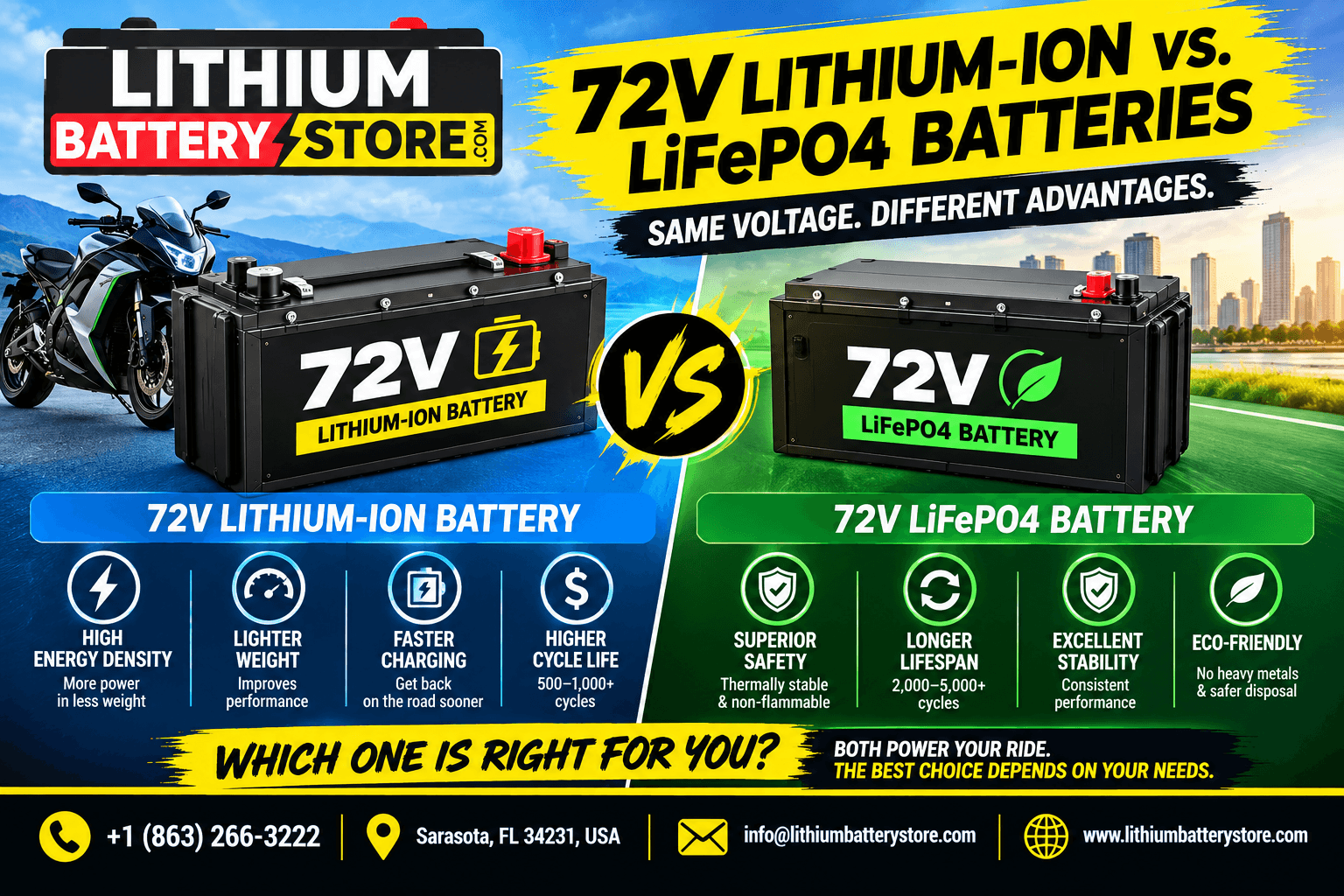
72V Lithium-Ion vs. LiFePO4 Batteries: Which Is Better for Electric Vehicles?
Choosing the right battery chemistry is an important decision for electric vehicle owners, manufacturers, and fleet operators. While both lithium-ion and lithium iron phosphate (LiFePO4) batteries can provide reliable power, they have different characteristics that can make one technology more suitable than the other for a particular vehicle.
Electric vehicles use batteries across several voltage categories, including 12V, 24V, 36V, 48V, 60V, and 72V systems. Among these, 72V battery systems are commonly considered for applications that require higher power and energy, including electric motorcycles, UTVs, utility vehicles, industrial vehicles, and certain commercial transportation applications.
So, when comparing 72V lithium-ion vs. LiFePO4 batteries, which one is better? The answer depends on the vehicle’s range requirements, weight limitations, expected usage, charging needs, operating environment, and desired battery lifespan.
Understanding 72V Battery Systems
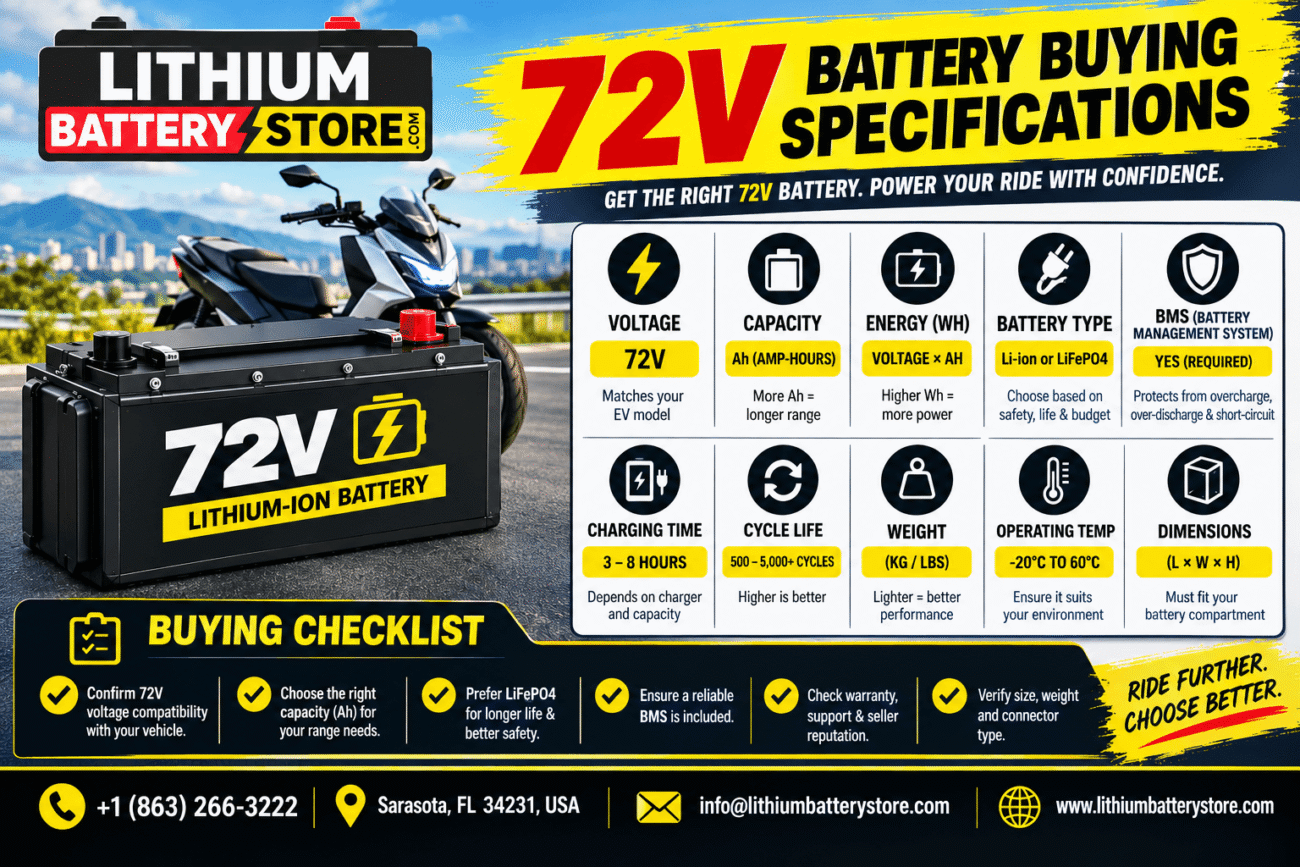
A 72V battery refers primarily to the battery system’s nominal voltage. Voltage determines how the battery interfaces with the vehicle’s electrical system, but it does not tell you how much energy the battery stores.
For example:
- 72V 20Ah = approximately 1.44 kWh
- 72V 30Ah = approximately 2.16 kWh
- 72V 40Ah = approximately 2.88 kWh
- 72V 50Ah = approximately 3.60 kWh
- 72V 60Ah = approximately 4.32 kWh
The same principle applies to lower-voltage categories such as 12V, 24V, 36V, 48V, and 60V. Battery capacity and chemistry determine how effectively that stored energy can be delivered and used.
For a 72V electric vehicle, selecting the right chemistry is therefore just as important as choosing the appropriate capacity.
What Is a 72V Lithium-Ion Battery?
Lithium-ion is a broad family of rechargeable battery technologies. Different lithium-ion chemistries can offer different combinations of energy density, power capability, lifespan, and thermal characteristics.
For electric vehicles where space and weight are important, a suitable lithium-ion battery can provide substantial energy in a relatively compact package.
This can make lithium-ion technology attractive for applications such as:
- Electric motorcycles
- Electric scooters
- Mini EVs
- Electric UTVs
- Lightweight utility vehicles
The specific performance of a lithium-ion battery depends on its cell chemistry, cell quality, BMS, construction, operating conditions, and manufacturer’s design.
What Is a 72V LiFePO4 Battery?
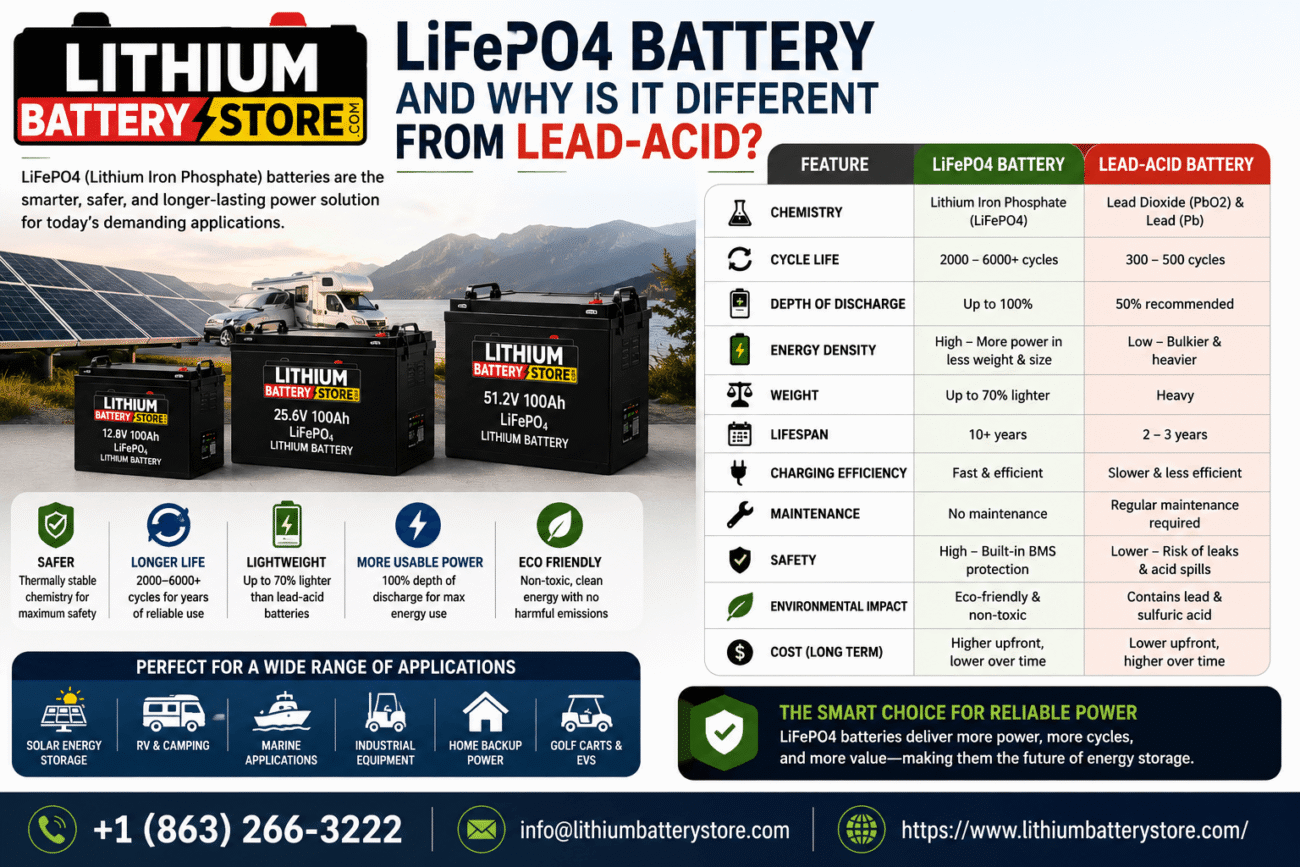
LiFePO4 stands for lithium iron phosphate. It is a lithium battery chemistry known for its durability and strong thermal characteristics.
LiFePO4 batteries are often considered for applications where long service life, consistent operation, and durability are major priorities.
They can be useful for applications such as:
- Utility vehicles
- Industrial vehicles
- Agricultural vehicles
- AGVs
- Fleet vehicles
- RV and camper applications
Like other lithium batteries, LiFePO4 systems require an appropriate battery management system and compatible charger.
Lithium-Ion vs. LiFePO4: Energy Density
One of the major considerations when comparing battery chemistries is energy density.
Energy density describes how much energy can be stored relative to the battery’s weight or volume. Higher energy density can be valuable when an electric vehicle has limited battery space or when minimizing weight is important.
Depending on the specific chemistry and cell design, conventional lithium-ion batteries can offer higher energy density than LiFePO4.
This can make lithium-ion attractive for electric motorcycles and other vehicles where reducing battery weight is particularly important.
However, energy density is only one part of the decision. A battery that is slightly heavier may still be preferable if its longer service life and durability better suit the application.
Battery Lifespan and Cycle Life
Battery lifespan is another major consideration.
LiFePO4 batteries are widely recognized for their strong cycle-life characteristics when properly designed and operated. This can be especially valuable for vehicles that are charged and discharged frequently.
For example, a commercial utility vehicle that operates throughout the day may place significantly more cycles on its battery than a personal vehicle used occasionally.
Lithium-ion batteries can also provide long service life, but actual lifespan varies significantly according to chemistry, cell quality, charging practices, depth of discharge, temperature, and battery management.
When comparing two batteries, look at the manufacturer’s stated cycle-life testing conditions rather than relying only on the chemistry name.
Weight Considerations
Battery weight can directly affect electric vehicle performance.
A lighter battery can help reduce overall vehicle weight, which may contribute to improved acceleration, handling, efficiency, and range under certain conditions.
This is one reason energy-dense lithium-ion battery systems can be attractive for electric motorcycles and lightweight electric vehicles.
LiFePO4 batteries may require more physical mass to store the same amount of energy compared with some lithium-ion chemistries. However, the additional weight may be acceptable in utility, industrial, agricultural, or fleet applications where durability and long-term operation are more important than minimizing weight.
Safety and Thermal Characteristics
Safety is an important consideration for every electric vehicle battery.
Battery safety depends on much more than chemistry. Cell quality, battery construction, electrical protection, BMS design, charging equipment, thermal management, and correct installation all play important roles.
LiFePO4 chemistry is known for strong thermal stability compared with some other lithium chemistries. This characteristic can make it attractive for applications where thermal performance is a major consideration.
A quality lithium-ion battery can also be designed with sophisticated protection systems. Features such as overcharge protection, over-discharge protection, over-current protection, temperature monitoring, and cell balancing can help manage battery operation.
Charging Performance
Charging requirements vary between battery systems.
Both lithium-ion and LiFePO4 batteries require chargers designed for their specific chemistry and voltage configuration. A 72V battery should not simply be paired with any charger labeled for 72V operation.
The charging profile, maximum charging voltage, current, BMS configuration, and connector must all be compatible.
For electric vehicle fleets, charging speed can have a significant impact on productivity. Vehicles that need to return to service quickly may require a battery and charging system specifically designed around their operational schedule.
Performance in Electric Vehicles
The best battery chemistry also depends on how the vehicle is used.
A high-performance electric motorcycle may prioritize:
- Low battery weight
- High power output
- Compact packaging
- Strong acceleration
- Good energy density
In this type of application, a suitable lithium-ion battery may be advantageous.
A commercial utility vehicle or AGV may instead prioritize:
- Long cycle life
- Frequent daily operation
- Durability
- Stable performance
- Lower long-term replacement frequency
In these situations, LiFePO4 can be an attractive option.
Which Battery Is Better for 72V Electric Motorcycles?
For electric motorcycles, weight and packaging can be especially important.
A motorcycle needs to balance battery capacity with handling, acceleration, range, and available installation space. A high-energy-density lithium-ion battery may therefore be an appealing choice when the goal is to maximize usable energy without adding unnecessary weight.
However, LiFePO4 can still be appropriate when durability, cycle life, and thermal characteristics are higher priorities.
The correct choice should be based on the motorcycle’s motor, controller, required range, battery compartment, current requirements, charger, and intended riding conditions.
Which Is Better for UTVs and Utility Vehicles?
Electric UTVs and utility vehicles often have different priorities than motorcycles.
These vehicles may carry heavier loads, operate at lower speeds, and spend extended periods working in demanding environments. In these cases, battery durability and long-term reliability can be more important than achieving the lowest possible battery weight.
A 72V LiFePO4 battery can be a strong candidate for these applications, provided the capacity and discharge specifications meet the vehicle’s requirements.
Which Is Better for Industrial and AGV Applications?
Industrial vehicles and automated guided vehicles can operate on predictable schedules and may undergo frequent charging cycles.
For these applications, battery cycle life, reliability, BMS performance, charging compatibility, and total operating cost are important considerations.
A LiFePO4 battery may be attractive where frequent cycling and long service life are key requirements. However, the final selection should be based on the vehicle manufacturer’s specifications and operating profile.
Cost: Look Beyond the Initial Price
The cheapest battery is not always the most economical choice.
When comparing lithium-ion and LiFePO4, consider the complete ownership cost, including:
- Initial purchase price
- Expected cycle life
- Charging efficiency
- Maintenance requirements
- Replacement frequency
- Downtime
- Energy capacity
- Installation requirements
A battery with a higher initial price may provide better long-term value if it lasts longer or reduces vehicle downtime.
How to Choose the Right 72V Battery
Before choosing a 72V lithium-ion or LiFePO4 battery, answer these questions:
- How much range does the vehicle require?
- What is the motor’s power rating?
- What current does the controller require?
- How much battery space is available?
- What battery weight can the vehicle accommodate?
- How frequently will the battery be charged?
- What temperatures will the vehicle operate in?
- What cycle life is required?
- Which charger is compatible?
- Does the BMS meet the vehicle’s electrical requirements?
These questions provide a much better basis for battery selection than choosing a chemistry based solely on price.
Final Verdict: Lithium-Ion or LiFePO4?
There is no single winner between 72V lithium-ion and LiFePO4 batteries.
Lithium-ion can be a strong choice when energy density, lower weight, compact design, and performance are important.
LiFePO4 can be a strong choice when cycle life, durability, and thermal characteristics are major priorities.
For electric motorcycles and lightweight EVs, lithium-ion may have an advantage when weight and energy density are critical. For utility, industrial, agricultural, and fleet applications, LiFePO4 may be attractive because of its durability and cycle-life characteristics.
Lithium Battery Store can help buyers research different battery configurations, but the final battery should always be selected according to the vehicle’s voltage, capacity, current, physical dimensions, charger requirements, and BMS compatibility.
Whether you are comparing 48V, 60V, or 72V systems, or evaluating battery options for an electric motorcycle, UTV, utility vehicle, or AGV, the best battery is the one that matches the complete vehicle system and its real-world operating requirements.
Frequently Asked Questions
Is LiFePO4 better than lithium-ion for electric vehicles?
Not universally. LiFePO4 can offer strong cycle life and thermal characteristics, while some lithium-ion chemistries offer higher energy density. The right choice depends on the vehicle and application.
Is a 72V LiFePO4 battery good for an electric motorcycle?
It can be, provided the motorcycle’s motor, controller, charger, BMS, and physical battery compartment are compatible with the battery system.
Which 72V battery gives better range?
Range depends primarily on usable energy, vehicle efficiency, riding conditions, and battery capacity. Comparing only lithium-ion versus LiFePO4 does not determine range.
Are 72V lithium-ion batteries safe?
A properly designed battery with quality cells, an appropriate BMS, suitable protection, and a compatible charger can be used safely when installed and operated according to manufacturer requirements.
Can I use the same charger for lithium-ion and LiFePO4 batteries?
Not necessarily. Charging profiles can differ by chemistry and battery design. Always use a charger specifically approved for the battery system.
Add a review
Your email address will not be published. Required fields are marked *