
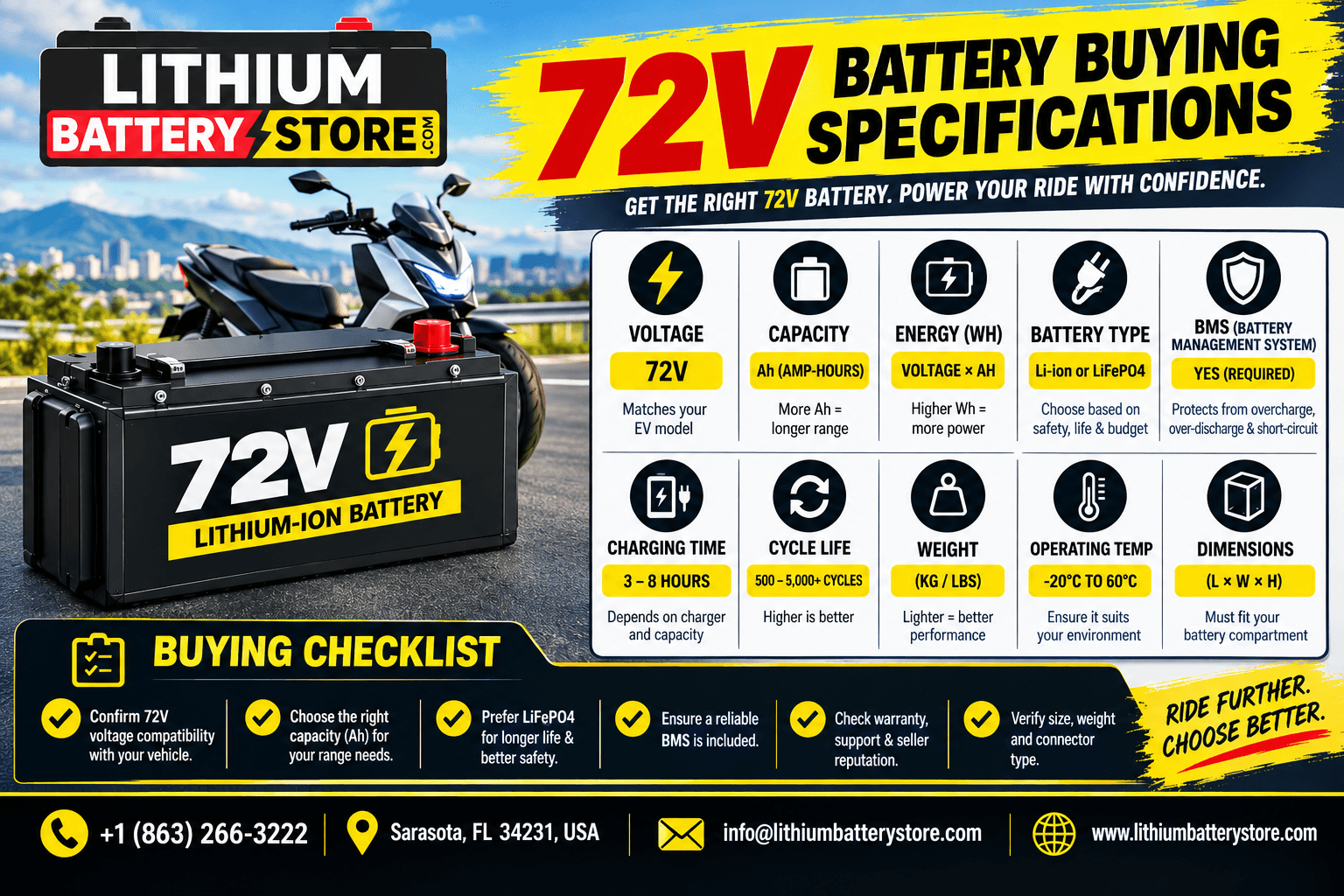
72V Battery Buying Guide: 10 Important Specifications to Check Before You Buy
Choosing the right battery is essential for getting reliable performance from an electric vehicle. While a battery may appear to be a simple power source, its voltage, capacity, discharge capability, chemistry, Battery Management System (BMS), dimensions, and charging requirements can all affect how well it performs.
Electric vehicles and equipment are available with different battery voltage categories, including 12V, 24V, 36V, 48V, 60V, and 72V. Lower-voltage systems are commonly found in smaller applications, while 72V systems can support higher-power electric vehicles such as electric motorcycles, UTVs, utility vehicles, and some industrial applications.
If you are considering a 72V battery, don’t choose one based on voltage or price alone. Here are 10 important specifications to check before buying a 72V battery.
1. Nominal Voltage
The first specification to verify is voltage.
A 72V battery is designed for an electrical system that operates around a 72V nominal voltage. The actual voltage of a lithium battery can be higher when fully charged and lower as the battery discharges.
Before buying, confirm that your vehicle, motor, and controller are designed for a 72V battery system.
Electric battery categories commonly include:
- 12V batteries – auxiliary and smaller electrical applications
- 24V batteries – compact equipment and light-duty vehicles
- 36V batteries – smaller electric mobility applications
- 48V batteries – scooters, utility vehicles, and other EVs
- 60V batteries – higher-performance electric vehicles
- 72V batteries – higher-power motorcycles, UTVs, utility vehicles, and other EV applications
Never assume that a higher voltage battery can simply replace a lower-voltage battery. The entire electrical system must be compatible.
2. Battery Capacity in Amp-Hours
The second specification is capacity, measured in amp-hours (Ah).
Ah indicates how much electrical charge the battery can theoretically store. For a battery with the same voltage, a higher Ah rating generally means more stored energy.
For example:
- 72V 20Ah = approximately 1.44kWh
- 72V 30Ah = approximately 2.16kWh
- 72V 40Ah = approximately 2.88kWh
- 72V 50Ah = approximately 3.60kWh
- 72V 60Ah = approximately 4.32kWh
The basic calculation is:
Voltage × Ah = Watt-hours
Therefore:
72V × 50Ah = 3,600Wh
When selecting capacity, consider your expected driving range, vehicle energy consumption, daily operating hours, and charging schedule.
3. Usable Energy
Nominal capacity doesn’t always represent the amount of energy that can actually be used by the vehicle.
Battery management systems may maintain a reserve to protect the cells from excessive discharge. Temperature, battery age, operating conditions, and manufacturer settings can also influence usable energy.
For this reason, ask about usable capacity as well as nominal capacity.
For example, a 72V 50Ah battery has approximately 3.6kWh of nominal energy, but the usable energy may be somewhat lower depending on the battery design.
When comparing two batteries, reviewing usable energy can give you a more realistic understanding of expected range.
4. Continuous and Peak Discharge Current
Battery capacity is not the only factor that determines performance. You should also check how much current the battery can safely deliver.
Two important specifications are:
- Continuous discharge current
- Peak discharge current
An electric motorcycle or UTV may require significantly more current during acceleration, hill climbing, or carrying heavy loads than during steady cruising.
For example, if the vehicle’s controller can demand high current but the battery has a low discharge rating, the system may experience reduced performance or protective shutdowns.
Always compare the battery’s discharge specifications with the motor and controller requirements.
5. Battery Management System
The Battery Management System (BMS) is one of the most important components in a modern lithium battery.
A BMS monitors and manages battery operation and may provide protection against conditions such as:
- Overcharging
- Over-discharging
- Over-current
- Short circuits
- Excessive temperature
- Cell imbalance
When purchasing a 72V battery, don’t simply ask whether it has a BMS. Check the BMS specifications, including its continuous and peak current capability and protection features.
For higher-power applications, BMS compatibility with the vehicle controller is particularly important.
6. Battery Chemistry
The sixth specification is battery chemistry.
Lithium batteries can use different chemistries, each with different characteristics.
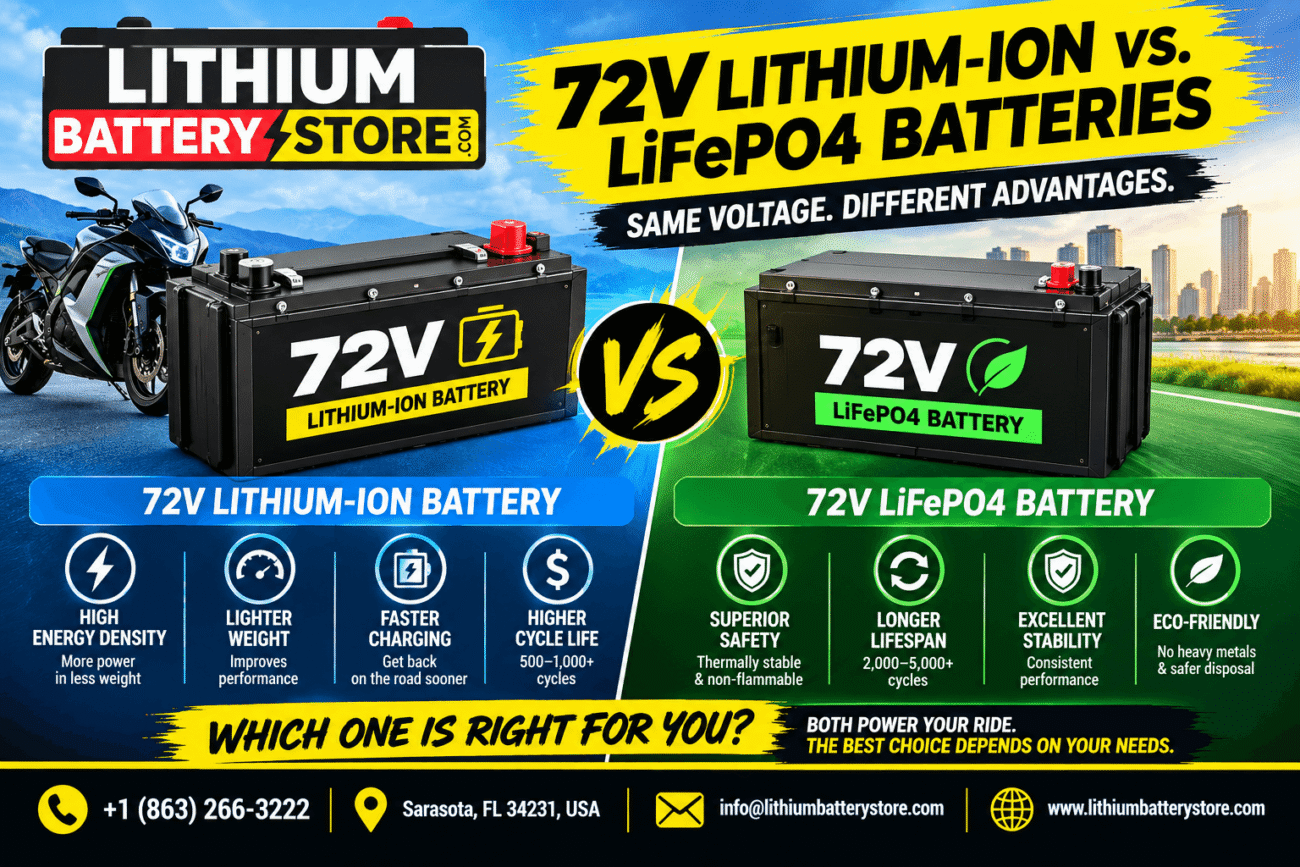
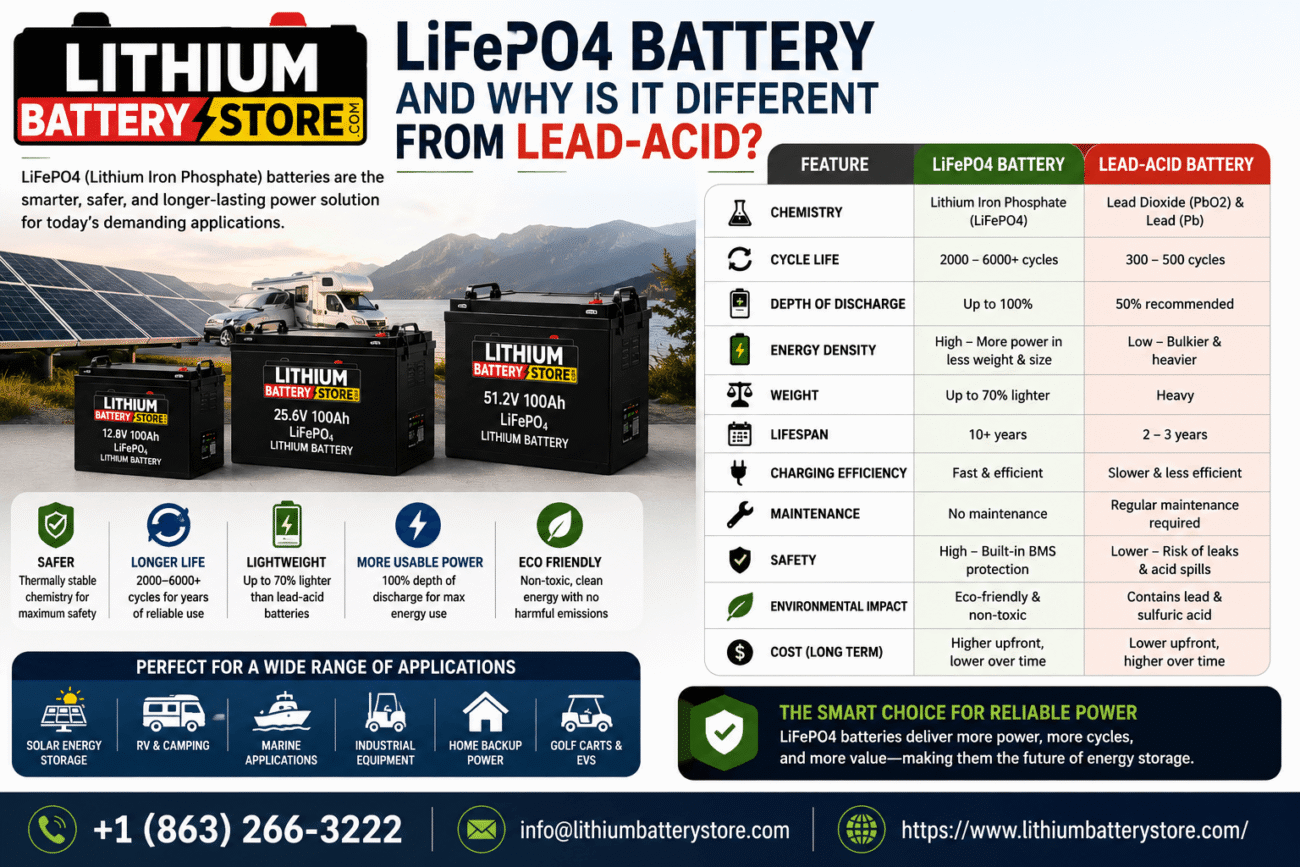
For example, lithium-ion batteries can offer attractive energy density and compact packaging for applications where weight is important. LiFePO4 (lithium iron phosphate) batteries are known for strong cycle-life characteristics and thermal stability.
The appropriate chemistry depends on the application.
A lightweight electric motorcycle may prioritize energy density and weight, while an industrial or utility vehicle may place greater importance on durability and frequent cycling.
Don’t choose chemistry based only on marketing claims. Review the manufacturer’s specifications for cycle life, energy density, operating temperature, charging requirements, and discharge performance.
7. Physical Dimensions and Weight
A battery can have the correct voltage and capacity and still be unsuitable if it doesn’t physically fit the vehicle.
Before buying, check:
- Length
- Width
- Height
- Weight
- Mounting points
- Cable location
- Connector position
- Required clearance
This is especially important for electric motorcycles and scooters, where battery compartments can be relatively compact.
Larger batteries can provide more energy, but additional capacity may also increase battery size and weight.
The ideal battery is not necessarily the largest one available. It should provide the required energy while fitting securely within the vehicle.
8. Charging Voltage and Charger Compatibility
The charger is an essential part of the battery system.
A 72V battery should be paired with a charger specifically designed for that battery’s chemistry and configuration.
Check:
- Charger output voltage
- Charging current
- Battery chemistry
- Charging connector
- BMS compatibility
- Manufacturer charging recommendations
Using an incompatible charger can create safety and performance problems.
If you are replacing an existing battery, don’t automatically assume that the old charger will work with the new battery. Verify compatibility before connecting the system.
9. Operating Temperature
Temperature can affect battery performance, charging, and service life.
Very cold or hot conditions can influence available capacity and charging behavior. For vehicles operating outdoors, temperature specifications can be particularly important.
When evaluating a 72V battery, review the manufacturer’s recommended:
- Discharge temperature range
- Charging temperature range
- Storage temperature range
For applications such as agricultural vehicles, outdoor utility vehicles, and UTVs, environmental conditions should be considered before selecting the battery.
10. Cycle Life and Warranty
The final specification to examine is expected cycle life and warranty coverage.
A battery cycle generally refers to using and recharging a portion or all of its available capacity. The number of cycles a battery can provide depends on chemistry, cell quality, depth of discharge, temperature, charging practices, and battery management.
When comparing batteries, look for cycle-life information under clearly stated testing conditions.
Also review the warranty carefully. Check what is covered, the warranty period, applicable operating conditions, and any limitations.
A battery with a higher purchase price may provide better long-term value if it offers longer service life and reduces replacement frequency.
How to Choose the Right 72V Battery
After checking the 10 specifications above, consider how the battery will actually be used.
For an electric motorcycle, weight, energy density, discharge current, dimensions, and range may be major priorities.
For an electric UTV, capacity, discharge capability, durability, weight, and environmental conditions may be more important.
For a utility or industrial vehicle, cycle life, reliability, charging speed, and total operating cost may receive greater consideration.
The right battery therefore depends on the complete application rather than one specification.
Don’t Confuse Voltage With Capacity
One of the most common battery-buying mistakes is assuming that voltage determines range.
It doesn’t.
For example:
48V × 60Ah = 2,880Wh
72V × 40Ah = 2,880Wh
Both batteries contain approximately the same nominal amount of energy, even though their voltage and Ah ratings are different.
This is why buyers should compare watt-hours or kilowatt-hours when evaluating energy storage.
Should You Choose the Largest 72V Battery?
Not necessarily.
A larger battery can provide greater energy capacity, but it may also increase cost, weight, and physical size.
Instead, determine:
- Required range or operating time
- Vehicle motor power
- Controller current requirements
- Available battery space
- Maximum acceptable battery weight
- Charging requirements
- Operating temperature
- Expected daily usage
- Desired service life
- Budget and total ownership cost
This approach can help you avoid buying either an undersized or unnecessarily oversized battery.
Final Buying Checklist
Before purchasing a 72V battery, confirm these 10 specifications:
✓ Nominal voltage
✓ Ah capacity
✓ Usable energy
✓ Continuous and peak discharge current
✓ BMS specifications
✓ Battery chemistry
✓ Dimensions and weight
✓ Charger compatibility
✓ Operating temperature
✓ Cycle life and warranty
Lithium Battery Store can be a useful starting point for researching battery options across different electric vehicle applications. However, always compare the battery specifications with your vehicle manufacturer’s requirements before making a purchase.
A good 72V battery is not simply the one with the highest Ah rating or the lowest price. The best option is one that provides sufficient energy, meets the vehicle’s power requirements, fits the available space, works with the charging system, and is designed for the conditions in which the vehicle will operate.
By checking these 10 specifications before buying, you can make a more informed decision and choose a 72V battery that offers an appropriate combination of performance, range, reliability, safety, and long-term value.
Frequently Asked Questions
What should I check before buying a 72V battery?
Check voltage, Ah capacity, usable energy, discharge current, BMS, battery chemistry, dimensions, weight, charger compatibility, operating temperature, cycle life, and warranty.
What does 72V mean on a battery?
72V refers to the battery’s nominal voltage. The vehicle’s motor, controller, charger, and electrical system should all be compatible with the 72V battery configuration.
How do I choose the right Ah for a 72V battery?
Choose the Ah capacity based on your required range or operating time, vehicle energy consumption, available battery space, and acceptable battery weight.
How much energy does a 72V 40Ah battery provide?
A 72V 40Ah battery provides approximately 2,880Wh or 2.88kWh of nominal energy, calculated as 72V × 40Ah.
What is BMS in a 72V lithium battery?
BMS stands for Battery Management System. It monitors the battery and can provide protection against overcharging, over-discharging, excessive current, temperature issues, and cell imbalance.
Is lithium-ion or LiFePO4 better for a 72V battery?
Neither is universally better. Lithium-ion can offer advantages in energy density and weight, while LiFePO4 is known for durability and strong cycle-life characteristics. The best choice depends on the application.
How important is the discharge current of a 72V battery?
It is very important for electric vehicles. The battery must be capable of supplying the current required by the motor and controller, particularly during acceleration and heavy loads.
Can I use any 72V charger with a 72V battery?
No. The charger must be compatible with the battery’s chemistry, charging voltage, current, BMS, and configuration. Always follow the battery manufacturer’s charging requirements.
Does a higher Ah rating mean a longer battery range?
Generally, a higher Ah rating provides more stored energy when voltage remains the same. However, actual range also depends on vehicle efficiency, speed, weight, terrain, weather, and driving conditions.
How do I know if a 72V battery will fit my vehicle?
Check the battery’s length, width, height, weight, mounting requirements, cable placement, and connectors against the available space and specifications of your electric vehicle.
Add a review
Your email address will not be published. Required fields are marked *