
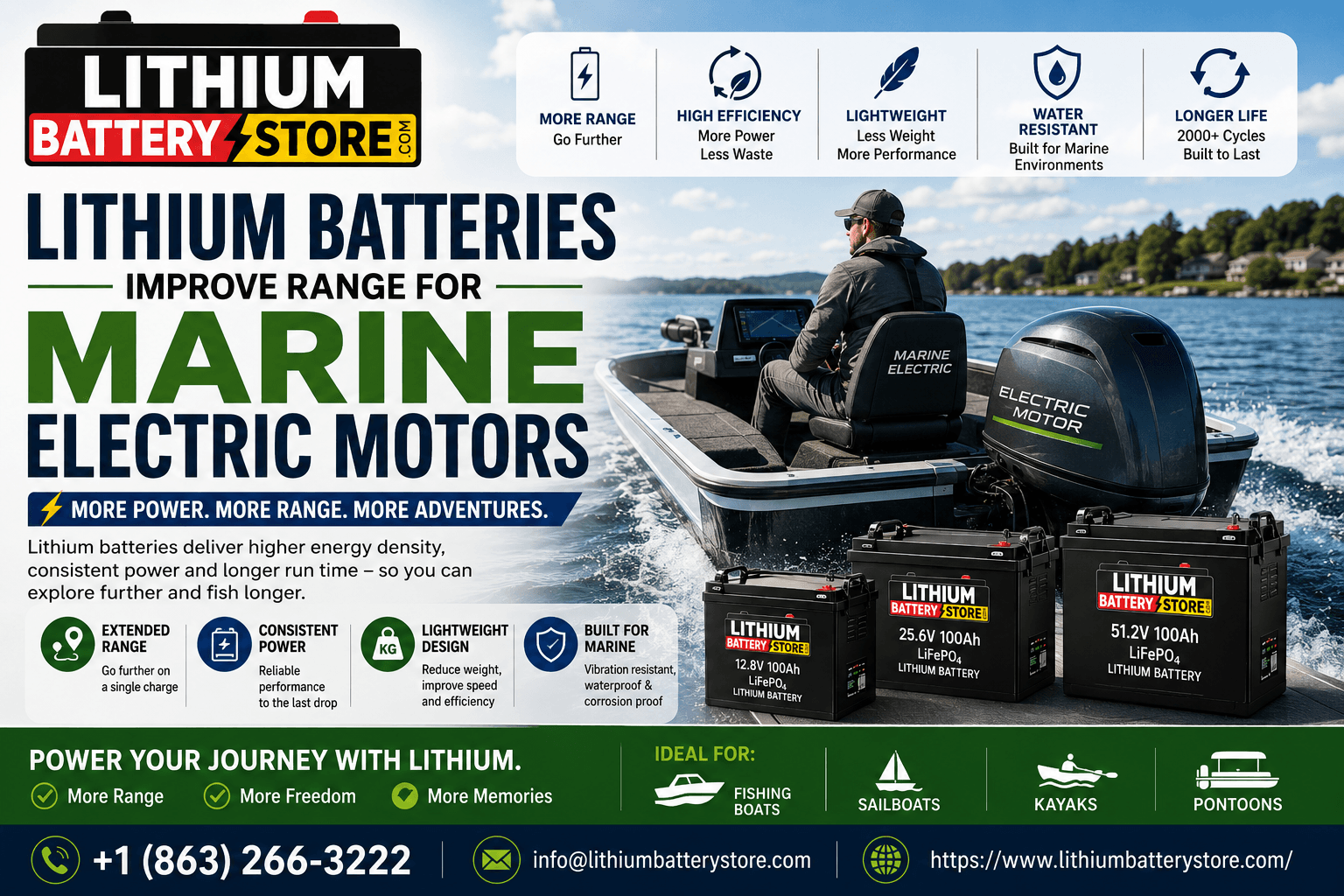
How Lithium Batteries Improve Range for Marine Electric Motors?
Electric propulsion is changing the way boaters think about time on the water. Whether it’s a small pontoon boat, a fishing skiff, or a fully electric cruiser, the biggest question owners ask is always the same: how far can I go before I need to recharge? The answer depends almost entirely on the battery bank powering the motor, and this is where lithium batteries have made the most dramatic difference.
Marine electric motors have existed for decades, but early systems were limited by heavy, low-capacity lead-acid batteries. Today, lithium battery technology — specifically lithium iron phosphate (LiFePO4) chemistry — has transformed what’s possible on the water. Boaters are seeing longer trips, faster charging, and more predictable performance than ever before. Here’s a closer look at why lithium batteries are the driving force behind better range for marine electric motors.
Why Range Matters So Much in Marine Applications
Unlike a car that can pull into a gas station or charging point along a highway, a boat’s “fuel stop” options are far more limited. Running out of power on the water isn’t just inconvenient — it can be genuinely unsafe, especially in open water, strong currents, or changing weather. This makes usable range one of the most important specifications for any electric marine motor setup.
Range is a function of three things: how much usable energy the battery bank can store, how efficiently that energy converts to thrust, and how much extra weight the boat has to carry to store it. Lithium batteries improve all three factors simultaneously, which is why they’ve become the standard choice for serious electric boating setups.
Higher Usable Energy Capacity
One of the most overlooked differences between lithium and lead-acid batteries is usable capacity. A traditional lead-acid battery typically shouldn’t be discharged below 50% without shortening its lifespan significantly. That means a 100Ah lead-acid battery really only offers around 50Ah of usable energy.
Lithium batteries, by contrast, can typically be discharged to 80-100% of their rated capacity without meaningful damage. A 100Ah lithium battery can deliver close to 100Ah of real, usable power. In practical terms, this alone can nearly double the effective range of a marine electric motor system using the same physical battery size, simply because more of the stored energy is actually accessible.
Significant Weight Savings
Weight is the enemy of range in any electric vehicle, and boats are no exception — extra weight increases drag and forces the motor to work harder, draining the battery faster. Lead-acid batteries are notoriously heavy due to their dense lead plates and liquid electrolyte.
Lithium batteries can weigh less than half of an equivalent lead-acid battery while delivering more usable energy. Lighter battery banks mean the hull sits higher in the water, the motor doesn’t have to compensate for extra mass, and every stored watt-hour goes further. Many boat owners who upgrade to lithium report noticeably better handling and speed in addition to extended range, purely as a side effect of reduced weight.
Consistent Voltage Under Load
Lead-acid batteries experience voltage sag as they discharge, meaning motor performance gradually drops off well before the battery is actually empty. Lithium batteries maintain a much flatter voltage curve throughout most of their discharge cycle. This means a marine electric motor keeps performing at near-full power output right up until the battery is close to depleted, instead of gradually losing thrust over the course of a trip.
This consistency translates directly into predictable range estimates. Boaters can plan trips with more confidence because the motor isn’t quietly losing efficiency as the battery drains, which is a common frustration with older lead-acid marine setups.
Faster, More Efficient Charging
Range isn’t only about how far you can go on a single charge — it’s also about how quickly you can get back on the water. Lithium batteries generally accept charge far faster than lead-acid batteries, which need to taper charging current significantly as they approach full capacity to avoid damage.
Faster charging means shorter downtime between outings, and for boaters who dock at a marina with shore power access, it can mean a full recharge overnight instead of over several days. Some lithium systems also support higher charge currents from solar panels or onboard generators, giving boaters more flexibility to top up range while underway.
Better Efficiency Across Temperature Ranges
Marine environments expose batteries to humidity, temperature swings, and constant vibration. Lead-acid batteries lose a meaningful portion of their capacity in cold conditions and can degrade faster in high-heat environments common on open water. Lithium batteries, particularly LiFePO4 chemistry, tend to hold their capacity more consistently across a wider temperature range, which helps preserve real-world range even in less-than-ideal conditions.
Longer Cycle Life Protects Range Over Time
Range isn’t just a day-one specification — it’s something that should hold up over years of use. Lead-acid batteries typically handle a few hundred charge cycles before capacity starts dropping noticeably. Lithium batteries, especially LiFePO4 options, are commonly rated for several thousand cycles while retaining a much higher percentage of their original capacity.
For boat owners, this means the range they get in year one is much closer to the range they’ll still have in year five. Choosing a quality lithium battery bank from a trusted supplier like Lithium Battery Store helps ensure that longevity claim actually holds up, since cell quality and battery management system (BMS) design vary significantly between manufacturers.
What to Look for When Choosing a Marine Lithium Battery
Not all lithium batteries are built the same, and marine use adds extra demands compared to land-based applications. When evaluating options, boaters should consider:
- Marine-rated enclosures that resist moisture, salt exposure, and vibration
- A quality built-in BMS to manage cell balancing, over-discharge protection, and thermal safety
- Amp-hour capacity matched to motor draw and expected trip duration
- Weight and physical dimensions that fit existing battery compartments
- Manufacturer support and warranty, since marine batteries often see harder use than automotive or RV batteries
Working with a specialized retailer such as Lithium Battery Store can simplify this process, since suppliers focused specifically on lithium systems are generally better positioned to match battery specifications to a boat’s motor, hull size, and typical usage pattern than a generalist marine parts store.
The Bottom Line
Lithium batteries improve range for marine electric motors through a combination of higher usable capacity, reduced weight, stable voltage output, faster charging, and long-term durability. Rather than a single improvement, it’s the compounding effect of all these factors together that has made lithium the preferred choice for boaters who want reliable, predictable performance on the water.
For anyone planning an upgrade from lead-acid to lithium, or building a new electric propulsion system from scratch, sourcing quality cells and a properly engineered battery pack matters just as much as the chemistry itself. Retailers like Lithium Battery Store that specialize in marine-grade lithium solutions can help boaters select the right battery bank for their specific motor, hull, and range requirements — turning the theoretical advantages of lithium into real, dependable time on the water.
Frequently Asked Questions
How do lithium batteries improve the range of marine electric motors?
Lithium batteries can improve range by storing more usable energy in a relatively lightweight and compact package compared with traditional lead-acid batteries. Their ability to provide high current also makes them well suited to electric propulsion systems. A lighter battery can reduce the overall weight of the boat, which may help the motor use less energy to maintain speed.
Why are lithium batteries more efficient for electric boats?
Lithium batteries generally offer higher energy density and can maintain strong power delivery during operation. This allows marine electric motors to access a substantial amount of stored energy without carrying the same weight associated with conventional battery technologies. The result can be improved efficiency, performance and cruising range, depending on the boat and operating conditions.
Does a larger lithium battery always mean greater boat range?
Not necessarily. Increasing battery capacity provides more stored energy, but actual range also depends on factors such as boat weight, hull design, speed, propeller selection, weather, currents and how much power the motor uses. For example, published marine motor testing shows that range can vary significantly between slow, half-throttle and full-throttle operation.
Can lithium batteries provide better range than lead-acid batteries?
They can. Lithium batteries typically provide more energy for their weight and can deliver power more effectively than conventional lead batteries. This can allow a boat to carry less battery weight while retaining useful energy capacity, potentially improving range and overall propulsion performance.
How does a battery management system affect marine electric motor range?
A battery management system (BMS) monitors important battery conditions and can help protect the battery from issues such as overcharging, overcurrent and deep discharge. Some marine propulsion systems also use battery and motor data to provide more accurate information about remaining capacity and estimated range.
How can Lithium Battery Store help me choose a battery for my marine electric motor?
Lithium Battery Store can help you select a battery based on your electric motor, boat size, voltage requirements and desired cruising range. Choosing the correct battery capacity and configuration is important because range depends on the complete propulsion system and how the boat is operated. A suitable marine battery can provide the energy and power needed for reliable electric boating while helping you make the most of your motor’s available range.

Add a review
Your email address will not be published. Required fields are marked *