
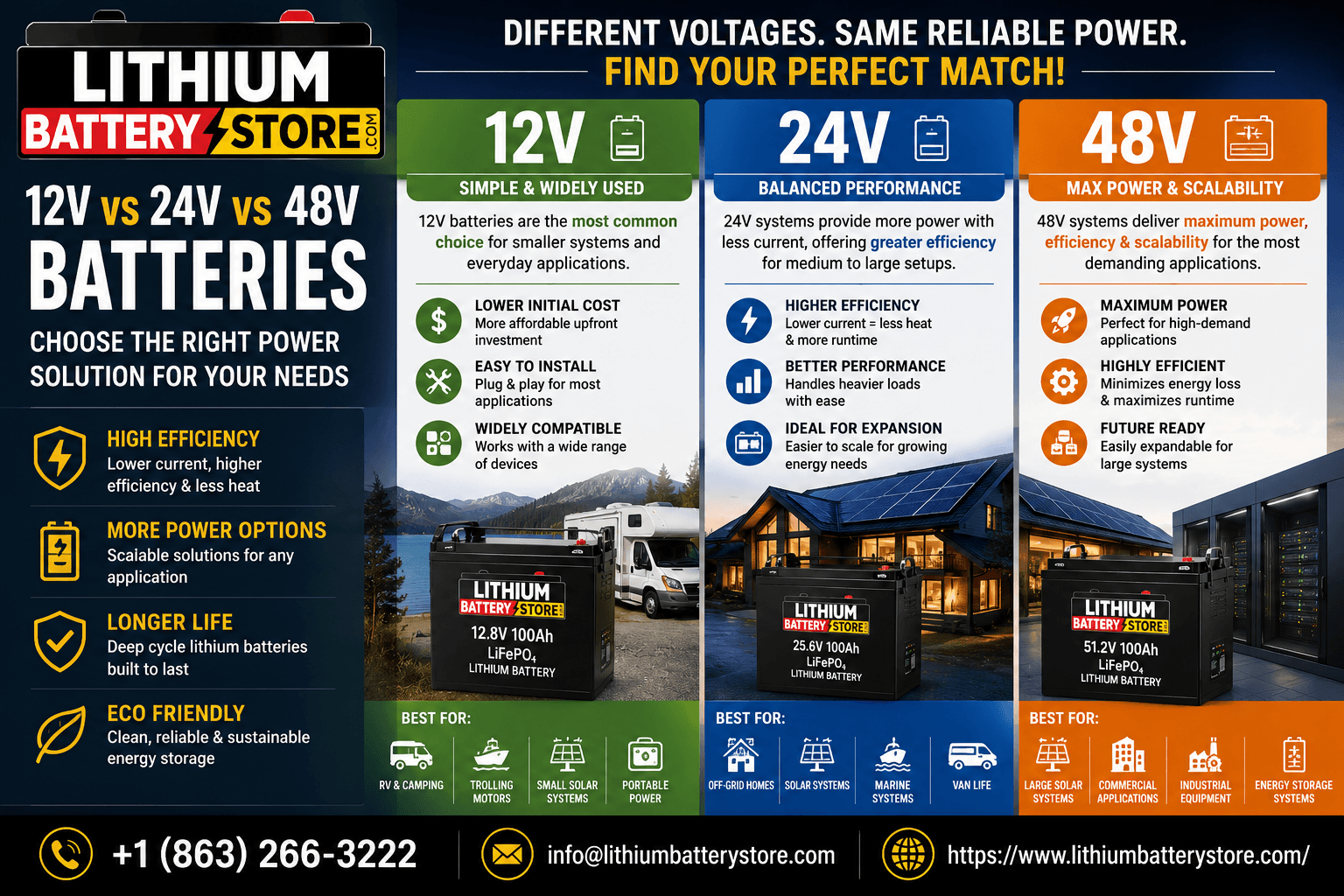
12V vs 24V vs 48V Lithium Batteries: Which Do You Need?
Quick answer: Choose a 12V battery for small systems like basic RV setups, small boats, or backup power for a few appliances. Choose a 24V battery for mid-sized applications such as larger trolling motors, golf carts, or moderate solar setups. Choose a 48V battery for larger systems, including whole-home solar backup, larger golf carts and off-road vehicles, and commercial or industrial equipment like forklifts, where higher power output and efficiency matter most.
Battery voltage isn’t just a technical spec, it directly affects how efficiently your system runs, how much current flows through your wiring, and how well your battery matches your appliances, motor, or inverter. Choosing the wrong voltage can mean inefficient power delivery, excess heat in your cabling, or a system that simply can’t keep up with demand. Here’s how to work out which voltage is right for your application.
Why Voltage Matters
At the same power output, a higher voltage system draws less current (amps) than a lower voltage one. Since heat and energy loss in cabling are directly related to current, higher voltage systems are generally more efficient, especially for setups covering longer wiring runs or drawing significant power. This is why larger systems, such as whole-home solar setups or industrial equipment, typically move to 48V rather than staying at 12V or 24V.
The formula behind this is simple: Power (Watts) = Voltage × Current. For the same wattage requirement, increasing the voltage reduces the current needed, which in turn reduces cable heating and voltage drop over distance.
12V Batteries: Best for Smaller, Simpler Systems
Common Uses
- Small RVs, campervans, and basic off-grid setups
- Small boats and marine trolling motors
- Backup power for a handful of essential appliances
- Small solar setups for cabins, sheds, or basic off-grid power
- Golf carts (in some smaller or older configurations)
Why Choose 12V
12V systems are the most common starting point for smaller power needs, largely because they’re widely supported by a huge range of consumer electronics, chargers, and accessories originally designed around traditional 12V lead-acid batteries. If you’re running a small number of appliances, a basic solar setup, or a smaller marine motor, a 12V LiFePO4 battery is often sufficient and typically the most straightforward option to source, wire, and maintain.
Limitations
As power demands increase, 12V systems require higher current to deliver the same wattage as a higher-voltage system, which means thicker cabling is often needed to handle that current safely and efficiently. For larger systems, this can make 12V setups less practical and more expensive to wire correctly.
24V Batteries: A Middle Ground for Moderate Power Needs
Common Uses
- Larger marine trolling motors requiring more sustained power
- Mid-sized golf carts and electric vehicles
- Moderate off-grid or backup solar systems
- Warehouse vehicles and some robotics applications
Why Choose 24V
24V systems offer a practical middle ground, delivering more power capability than a 12V setup while still being manageable in terms of wiring and component availability. For applications like larger trolling motors or mid-sized golf carts, a 24V battery can deliver noticeably better performance and range compared to a 12V system, without the added complexity that sometimes comes with 48V setups.
Limitations
While more efficient than 12V for higher-power applications, 24V systems still draw more current than an equivalent 48V setup at the same wattage, so very large or high-demand systems may still benefit more from moving up to 48V.
48V Batteries: Built for Higher-Power Applications
Common Uses
- Whole-home or larger off-grid solar backup systems
- Larger golf carts and off-road electric vehicles
- Commercial and industrial equipment, including forklifts and warehouse vehicles
- Larger marine propulsion systems
- Yachts and higher-demand electric vehicle applications
Why Choose 48V
For systems with higher power demands, 48V batteries deliver significantly more power while keeping current draw, and therefore cable heating and energy loss, lower than an equivalent 12V or 24V setup. This makes 48V the standard choice for larger solar installations, commercial vehicles, and applications where consistent, efficient power delivery matters most.
48V batteries are also commonly used as direct replacements for combinations of smaller batteries wired in series. Rather than connecting several 12V batteries together to reach 48V, using a single dedicated 48V battery reduces the number of connection points, simplifies wiring, and avoids potential balancing issues between individual cells in a series setup.
Limitations
48V systems and their associated components, including chargers and inverters, are generally more expensive upfront than 12V or 24V equivalents, and may be more than necessary for smaller applications with modest power needs.
Quick Comparison: 12V vs 24V vs 48V
| Factor | 12V | 24V | 48V |
| Best for | Small systems, basic appliances | Mid-sized motors, moderate solar | Large systems, commercial/industrial use |
| Current draw at same wattage | Highest | Moderate | Lowest |
| Cabling requirements | Thicker cables needed for higher power | Moderate | Thinner cables possible for same power |
| Typical applications | Small RVs, small boats, cabins | Larger trolling motors, mid-sized golf carts | Whole-home solar, forklifts, larger EVs |
| Component availability | Widest range | Moderate | Growing, but more specialized |
| Upfront cost | Generally lowest | Moderate | Generally highest |
Should You Wire Batteries in Series Instead?
It’s technically possible to reach a higher voltage by wiring multiple lower-voltage batteries together in series, for example, connecting two 24V batteries to reach 48V. However, it’s generally better to choose a single battery rated for your target voltage rather than relying on series connections.
Choosing the Right Voltage for Your Application
At Lithium Battery Store, we stock LiFePO4 batteries across 12V, 24V, 36V, 48V, and 72V configurations, suited to everything from small RV and marine setups to larger solar installations and commercial or industrial vehicles. If you’re unsure which voltage best matches your application, our team can help you work through your power requirements and recommend the right battery and charger combination.
Browse our full range of lithium batteries or get in touch with our team for personalized advice.
Frequently Asked Questions
What voltage battery do I need for a solar system?
This depends on your system size. Small off-grid setups often use 12V or 24V, while larger or whole-home solar backup systems typically move to 48V for improved efficiency.
Is a 48V battery always better than 12V or 24V?
Not necessarily. A 48V battery is more efficient for high-power applications, but for smaller systems, a 12V or 24V battery is often simpler, more cost-effective, and perfectly adequate.
Can I connect lower-voltage batteries to reach a higher voltage?
Yes, this is possible through series wiring, but it’s generally better to use a single battery rated for your target voltage where available, to reduce complexity and potential balancing issues.
Do 12V, 24V, and 48V batteries use different chargers?
Yes. Battery chargers are voltage-specific, so it’s important to choose a charger rated for your exact battery voltage and capacity.


Add a review
Your email address will not be published. Required fields are marked *