
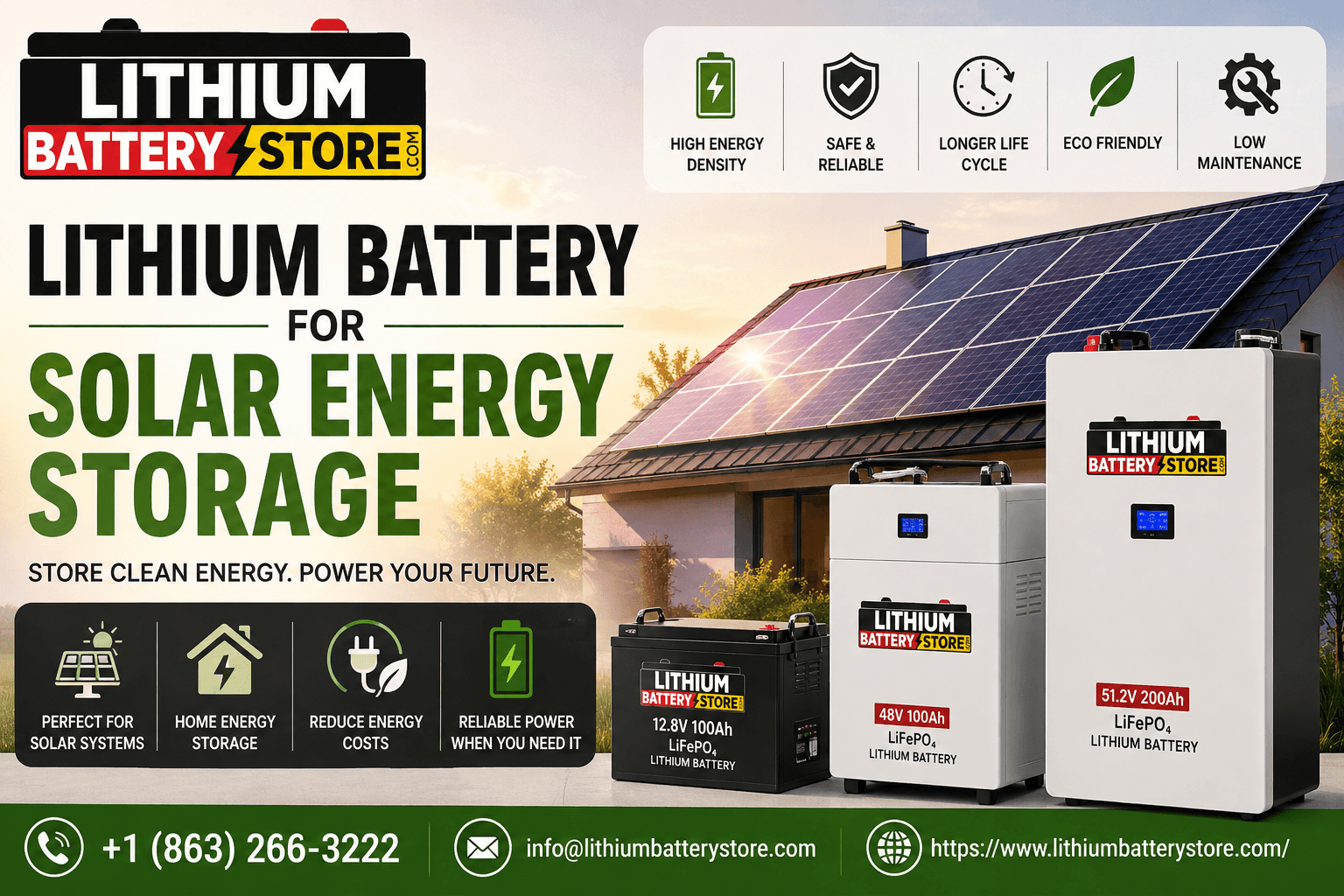
How to Choose a Lithium Battery for Solar Energy Storage?
Quick answer: The right lithium battery for solar energy storage depends on three main factors: your system’s voltage (commonly 12V, 24V, or 48V), your daily energy usage in amp-hours (Ah) or kilowatt-hours (kWh), and how many days of backup power you want without sunlight. LiFePO4 (lithium iron phosphate) batteries are the standard choice for solar storage due to their long cycle life, safety, and consistent performance, with most solar batteries ranging from 100Ah to 300Ah depending on system size.
Choosing a battery for a solar energy storage system isn’t just about picking a large capacity and hoping it’s enough. Matching the battery to your solar panel output, your inverter, and your actual daily energy consumption makes the difference between a system that reliably powers your home or off-grid setup and one that falls short when you need it most. This guide walks through exactly how to make that decision.
Why LiFePO4 Is the Standard for Solar Storage
Lithium Iron Phosphate (LiFePO4) batteries have become the go-to choice for solar energy storage, replacing older lead-acid and AGM battery banks. Compared to lead-acid batteries, LiFePO4 batteries offer:
- A significantly longer cycle life, often rated for thousands of charge cycles at full depth of discharge, compared to a few hundred for lead-acid
- Higher usable capacity, since LiFePO4 batteries can typically be discharged to 100% depth of discharge (DoD) without damage, while lead-acid batteries are usually limited to 50% DoD to preserve their lifespan
- Lighter weight, making installation and mounting easier, particularly for off-grid cabins, vans, or remote installations
- More consistent voltage output throughout the discharge cycle, which helps connected appliances and inverters perform more reliably
- Lower long-term cost, since the extended lifespan typically offsets the higher upfront price compared to repeatedly replacing lead-acid batteries
Step 1: Determine Your System Voltage
Solar battery systems are commonly built around 12V, 24V, or 48V configurations, and choosing the right one depends on the size of your system and the appliances or inverter you’re powering.
- 12V systems are typically suited to smaller setups, such as cabins, small off-grid systems, or supplementary storage for basic appliances.
- 24V systems offer a step up in power handling and are common in mid-sized off-grid or backup power setups.
- 48V systems are generally recommended for larger solar installations, whole-home backup power, or setups powering higher-demand appliances, since higher voltage systems can carry more power with less energy loss over cabling.
As a general rule, it’s better to choose a single battery rated for your target voltage rather than wiring multiple lower-voltage batteries in series to reach it. A dedicated 48V battery, for example, is generally more efficient and reliable than connecting four 12V batteries in series, and avoids the extra wiring, connection points, and balancing issues that come with series configurations.
Step 2: Calculate Your Daily Energy Usage
Before choosing a battery capacity, you need a reasonably accurate picture of how much energy your system needs to store and deliver each day. This involves adding up the power draw (in watts) of everything you plan to run, multiplied by how many hours per day you expect to use it, to arrive at your total daily watt-hour (Wh) usage.
Once you know your daily Wh requirement, you can convert this to amp-hours (Ah) for your chosen system voltage using the formula:
Ah needed = Total Wh ÷ System Voltage
For example, a system with a daily usage of 2,400Wh on a 24V setup would need approximately 100Ah of battery capacity to cover a single day’s use, before accounting for any additional backup days.
Step 3: Decide How Many Days of Backup You Need
Solar energy storage isn’t just about covering daily use, it’s also about having enough reserve capacity for cloudy days or periods with reduced sunlight. Most solar storage setups are sized to provide at least one to three days of backup power, depending on the reliability of sunlight in your location and how critical continuous power is for your needs.
If you’re in an area with frequent cloud cover or want a larger safety margin, sizing your battery bank for two to three days of autonomy is generally a safer approach than sizing for daily use alone.
Step 4: Check Compatibility with Your Solar Charge Controller and Inverter
Not every lithium battery is automatically compatible with every solar charge controller or inverter. Before purchasing, it’s worth confirming:
- That your charge controller supports LiFePO4 charging profiles, since lithium batteries have different charging voltage requirements than lead-acid
- That your battery’s built-in Battery Management System (BMS) is compatible with your intended application, particularly for higher-power setups
- That your inverter’s voltage input matches your chosen battery system voltage
Many solar batteries, including most modern LiFePO4 models, come with upgraded BMS protection as standard, but it’s still worth confirming compatibility with your specific charge controller and inverter setup before installation.
Common Solar Storage Applications
Off-Grid Cabins and Small Solar Setups
Smaller off-grid systems, such as cabins or sheds, typically work well with a single 12V or 24V LiFePO4 battery in the 100Ah–200Ah range, depending on daily energy needs.
Whole-Home Backup and Larger Off-Grid Systems
Larger installations powering a full home or multiple high-demand appliances generally benefit from a 48V system, often using higher-capacity batteries or multiple units connected in parallel to reach the required storage capacity.
Generator Replacement Systems
LiFePO4 battery banks paired with solar panels and a charge controller are increasingly used as a full generator replacement, offering quieter, maintenance-free power with no fuel costs. These setups typically require careful sizing based on peak load demands as well as daily usage, since generator-replacement systems often need to handle higher instantaneous power draws.
Choosing the Right Solar Battery for Your System
At Lithium Battery Store, we supply a full range of LiFePO4 batteries across 12V, 24V, 36V, 48V, and 72V configurations, suited to solar storage systems of all sizes, from small off-grid cabins to full generator-replacement setups. Our team is happy to help you work through voltage, capacity, and compatibility questions to find the right battery, and the right charger, for your specific solar application. Browse our solar battery range or get in touch with our team for personalized sizing advice.
Frequently Asked Questions
What size lithium battery do I need for solar power?
This depends on your daily energy usage and desired backup days. As a starting point, calculate your daily watt-hour usage, convert it to amp-hours for your system voltage, then multiply by the number of backup days you want.
Can I use a 12V battery for a whole-home solar system?
It’s possible for small loads, but larger or whole-home systems generally perform more efficiently on 24V or 48V systems, since higher voltage reduces current draw and energy loss across cabling.
Do LiFePO4 batteries work well in cold climates?
LiFePO4 batteries generally perform well in a wide range of temperatures, though charging in very cold conditions can require specific BMS protections. Checking a battery’s rated temperature range is worthwhile for installations in colder climates.
How many solar batteries do I need?
This depends on your total capacity requirement. If a single battery doesn’t meet your Ah needs, multiple batteries of the same voltage can typically be connected in parallel to increase total capacity.


Add a review
Your email address will not be published. Required fields are marked *