

Choosing the Right 72V Lithium Battery Pack for Electric Vehicles
Electric vehicles require a reliable battery system to deliver consistent power, dependable performance, and efficient operation. Whether you operate an electric ATV, motorcycle, scooter, utility vehicle, mini EV, or industrial vehicle, choosing the right battery pack is essential for getting the best results from your vehicle.
A 72V lithium battery pack can be a suitable power solution for electric vehicles designed to operate with a compatible 72V system. Among the available battery technologies, lithium iron phosphate batteries, commonly known as LiFePO4 batteries, are worth considering because of their cycle life, stable chemistry, and reduced maintenance requirements.
However, selecting a battery involves more than matching the voltage. Capacity, discharge current, battery management system protection, charger compatibility, physical dimensions, and operating conditions all play an important role.
In this guide, we explain how to choose the right 72V lithium battery pack for electric vehicles and what to check before purchasing a replacement or upgrade.
Why Choose a 72V Lithium Battery Pack?
Lithium battery technology is widely used in electric mobility and industrial applications. When matched to the vehicle’s electrical system, a suitable lithium battery pack can offer several advantages.
Longer Battery Service Life
LiFePO4 batteries are known for their potential to deliver many charge and discharge cycles under appropriate operating conditions. Their actual service life depends on cell quality, charging habits, operating temperature, depth of discharge, and battery management.
For vehicles used regularly, a quality LiFePO4 battery may offer a practical long-term alternative to conventional lead acid batteries.
Reduced Maintenance
Many lithium iron phosphate battery packs do not require the routine electrolyte checks and watering associated with flooded lead acid batteries.
This can simplify maintenance for electric vehicles used in transportation, agriculture, commercial facilities, and industrial environments.
Lower Battery Weight
Lithium batteries generally have a higher energy density than lead acid batteries. Depending on the battery configuration, a lithium replacement may reduce the total battery system weight.
Lower weight can be beneficial for electric scooters, motorcycles, ATVs, and utility vehicles. However, the actual effect on vehicle handling and performance depends on the vehicle design and battery placement.
Consistent Power Delivery
A properly matched LiFePO4 battery can maintain relatively stable voltage across much of its discharge cycle. This can help support consistent operation when the battery and motor controller are compatible.
The battery must also provide sufficient current during acceleration, hill climbing, and other periods of increased electrical demand.
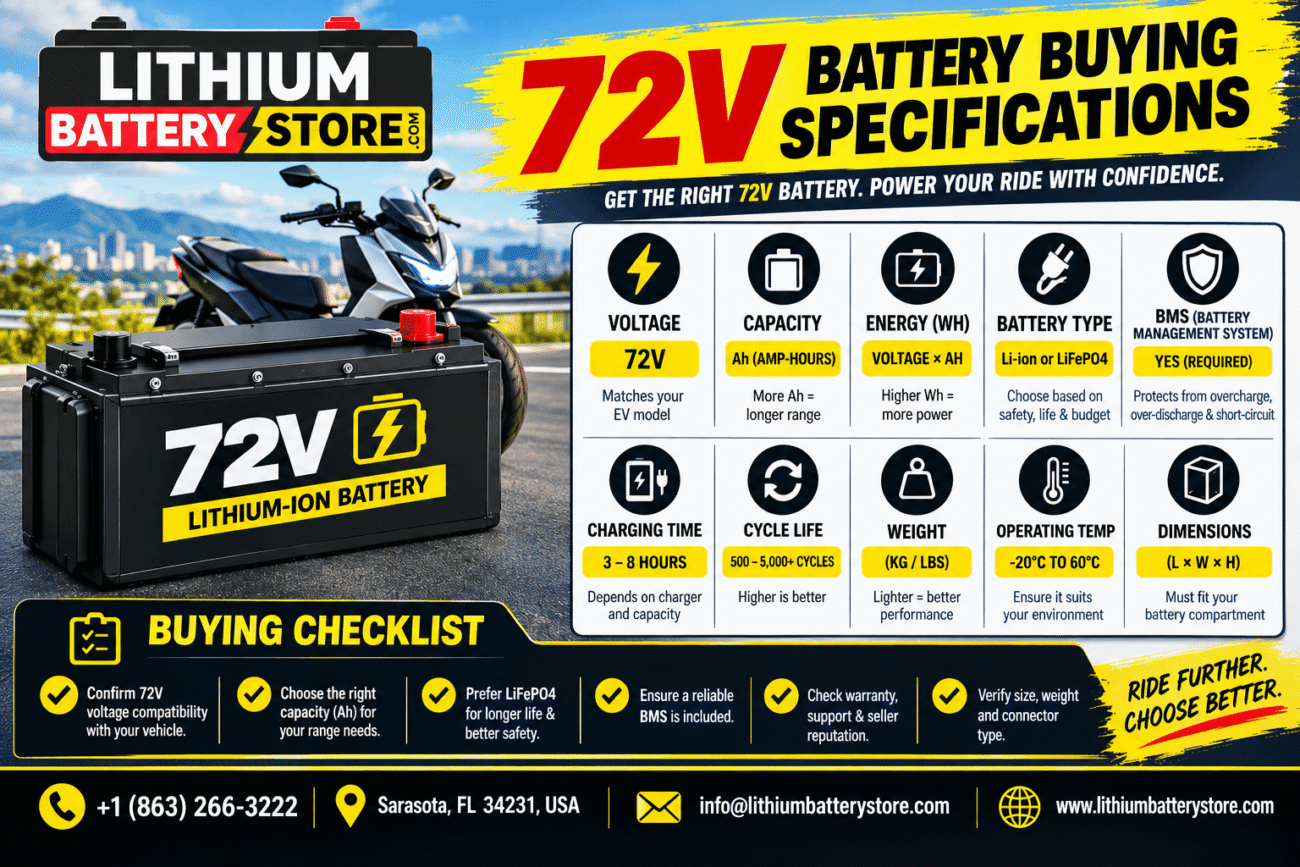
1. Confirm Your Vehicle’s Voltage Requirements
The first step in selecting a 72V lithium battery pack is confirming that your vehicle supports the battery’s electrical specifications.
Vehicles marketed as 72V may use different battery chemistries and cell configurations. As a result, their nominal voltage and full-charge voltage may differ.
Before purchasing a replacement battery, check the following:
- Original battery voltage and chemistry
- Motor controller operating voltage range
- Required full-charge voltage
- Minimum battery operating voltage
- Vehicle manufacturer’s battery specifications
A battery that is incompatible with the motor controller may cause operational problems or damage electrical components.
Do not assume that every battery advertised as a 72V lithium battery is suitable for every electric vehicle. Confirm the complete voltage specifications with the vehicle manufacturer or a qualified technician.
2. Select the Right Battery Capacity
Battery capacity is generally measured in amp-hours (Ah), while energy is measured in watt-hours (Wh).
Amp-hours indicate the amount of electrical charge a battery can store. Watt-hours provide a more useful estimate of the battery’s nominal energy capacity.
For example, a nominal 72V 50Ah battery provides approximately 3,600Wh of nominal energy. A nominal 72V 100Ah battery provides approximately 7,200Wh.
These figures represent nominal energy, not guaranteed usable energy or driving range.
When choosing capacity, consider how long your vehicle needs to operate between charges. A small electric utility vehicle used for occasional short trips may have different requirements from an ATV used on challenging terrain or an industrial vehicle operating for extended shifts.
Factors to consider include daily travel distance, vehicle load, terrain, average speed, motor efficiency, and charging frequency.
Choosing a suitable capacity helps balance operating time, battery cost, weight, and available installation space.
3. Check Continuous and Peak Discharge Current
Battery discharge capability is particularly important for electric vehicles because motors can demand substantial current during acceleration and heavy operation.
Two specifications deserve close attention.
Continuous discharge current is the current a battery can supply under its specified operating conditions.
Peak discharge current is the higher current it can supply for a limited period, according to the manufacturer’s rating.
For example, an electric ATV climbing a steep slope may require more current than a utility vehicle traveling on flat ground. The selected battery must be able to support the current demanded by the motor controller.
A battery with insufficient discharge capability may trigger BMS protection, interrupt vehicle operation, or fail to deliver the expected performance.
Always compare the battery’s current ratings with the controller and motor requirements before purchasing.
4. Choose a Lithium Battery with BMS Protection
A battery management system, commonly known as a BMS, monitors the battery pack and provides protective functions according to its design.
For a 72V lithium battery pack, the BMS is an important component because it helps monitor battery operating conditions and can protect against issues such as overcharging, excessive discharge, overcurrent, and temperature extremes.
When comparing battery packs, check the following features:
- Overvoltage and undervoltage protection
- Continuous and peak current ratings
- Temperature monitoring and protection
- Cell balancing capabilities
- Short-circuit protection
- Communication features, where required
The BMS must be appropriate for the battery’s cell configuration and the vehicle’s electrical demands.
For demanding applications such as electric ATVs, utility vehicles, and industrial equipment, selecting the correct BMS current rating is especially important.
5. Verify Charger Compatibility
A 72V lithium battery pack needs a charger compatible with its chemistry and electrical specifications.
A charger originally supplied with a lead acid battery system should not automatically be used with a LiFePO4 battery. Charging voltage, charging profile, and BMS requirements must all be considered.
Before selecting a charger, verify its output voltage, charging current, charging profile, and compatibility with the battery manufacturer’s recommendations.
Some battery systems also require communication between the battery and charger. If this is necessary, confirm that the selected components support the required communication protocol.
Using a compatible charger can help support safe charging and maintain battery performance over time.
6. Consider Battery Dimensions and Installation Requirements
A battery pack can meet the vehicle’s voltage and current requirements yet still be unsuitable because of its size or connection arrangement.
Measure the available battery compartment and compare it with the dimensions of the proposed battery.
Check the following details:
- Battery length, width, and height
- Weight and mounting requirements
- Terminal position and connector type
- Cable size and connection arrangement
- Enclosure protection and ventilation requirements
- Clearance for maintenance and inspection
The battery should be securely mounted and protected against movement and vibration during normal operation.
Electrical installation should use appropriately rated cables, connectors, fuses, and protective components. A qualified technician should assess any conversion that requires changes to the original wiring or vehicle controller.
7. Choose a Battery for Your Vehicle Application
Different electric vehicles have different power and energy requirements. The best battery configuration depends on the vehicle’s intended use.
Electric ATVs and Off Road Vehicles
Electric ATVs may need high discharge current during acceleration and climbing. A suitable 72V LiFePO4 battery should meet the controller’s current requirements and be designed for the environmental conditions associated with off road use.
Electric Motorcycles and Scooters
Two-wheeled electric vehicles require careful attention to battery weight, dimensions, discharge capability, and available installation space. Check the manufacturer’s specifications before choosing a replacement battery.
Utility Vehicles and Mini EVs
Utility vehicles and mini EVs may prioritize operating time, dependable power, and reduced maintenance. Select a battery with suitable capacity and verify its compatibility with the vehicle’s electrical system.
Industrial Vehicles and AGVs
Industrial vehicles and automated guided vehicles may operate for extended periods or under demanding duty cycles. Battery selection should account for charging schedules, continuous power requirements, operating temperature, and any vehicle communication requirements.
A battery designed for one application should not be assumed to be suitable for another without a technical compatibility assessment.
8. Compare Battery Quality, Warranty, and Supplier Support
Battery specifications are important, but supplier support also matters when choosing a long-term power solution.
Look for clearly documented cell specifications, battery capacity, discharge ratings, BMS features, charging instructions, warranty terms, and operating limits.
Lithium Battery Store can be a starting point for exploring lithium battery options for compatible electric vehicles and utility applications.
Before purchasing a 72V lithium battery pack, provide the vehicle model, model year, original battery specifications, and motor controller details. Ask the supplier to confirm the battery’s nominal voltage, full-charge voltage, capacity, current ratings, dimensions, and charger requirements.
Lithium Battery Store can also be contacted to discuss the technical information needed to evaluate a suitable battery configuration for your application.
Choosing a battery based on documented specifications rather than voltage alone can help reduce compatibility problems.
How to Maintain a 72V LiFePO4 Battery
Proper care can help support reliable operation and extend battery service life.
Use only a compatible charger and follow the manufacturer’s charging instructions. Keep the battery within its specified operating temperature range and avoid exposing it to conditions beyond its environmental rating.
Inspect cables, connectors, mounting hardware, and the battery enclosure periodically. Follow the manufacturer’s recommendations for storage if the vehicle will remain unused for an extended period.
Do not bypass the BMS or continue operating a battery that shows signs of physical damage, unusual heating, or repeated protection shutdowns.
Regular inspections and correct charging practices can help maintain dependable battery performance.
Conclusion
Choosing the right 72V lithium battery pack for an electric vehicle requires careful consideration of voltage, capacity, discharge current, BMS protection, charger compatibility, physical dimensions, and operating conditions.
LiFePO4 batteries can offer reduced maintenance, a potentially long cycle life, and lower weight compared with many lead acid alternatives. However, the benefits depend on selecting a suitable battery and installing it correctly.
Before purchasing a replacement or upgrade, verify your vehicle’s specifications and confirm compatibility with the battery manufacturer or a qualified technician.
By evaluating these factors carefully, you can choose a reliable battery solution for your electric ATV, motorcycle, scooter, utility vehicle, or other compatible electric vehicle.
Frequently Asked Questions
What is the best 72V lithium battery pack for electric vehicles?
The best battery pack is one that matches the vehicle’s voltage range, capacity requirements, discharge current, charging system, and physical dimensions. LiFePO4 batteries are worth considering for applications that benefit from reduced maintenance and cycle life.
What is the difference between a 72V 50Ah and a 72V 100Ah lithium battery?
Both batteries have the same nominal voltage, but the 100Ah battery has approximately twice the nominal energy capacity of the 50Ah battery. Actual usable energy and operating time depend on the battery design and vehicle conditions.
Are LiFePO4 batteries suitable for electric ATVs?
They can be suitable for ATVs designed for a compatible LiFePO4 battery system. The pack must provide adequate discharge current, appropriate environmental protection, and a compatible charging profile.
Does a 72V lithium battery need a BMS?
A suitable BMS is an important part of a lithium battery pack. It monitors operating conditions and provides protective functions based on its design. The BMS must support the battery configuration and the vehicle’s current requirements.
Can I use a lead acid charger with a 72V lithium battery?
Only if the battery manufacturer confirms that the charger is compatible with the specific lithium battery pack. The charger’s output voltage and charging profile must meet the battery manufacturer’s requirements.
How long does a 72V LiFePO4 battery last?
Battery lifespan depends on cell quality, temperature, depth of discharge, charging habits, and operating conditions. Check the manufacturer’s cycle-life rating, warranty, and recommended usage conditions.
Can a 72V lithium battery increase electric vehicle range?
A suitable battery with greater usable energy may increase operating range. However, actual range also depends on vehicle efficiency, motor power, terrain, speed, load, temperature, and riding or driving style.
How do I find a compatible 72V battery for my electric vehicle?
Check the vehicle’s model, original battery voltage, controller specifications, charger requirements, current demand, and battery compartment dimensions. Share these details with the battery supplier before purchasing.
Add a review
Your email address will not be published. Required fields are marked *